
Last updated November 27, 2026. Educational content only, not financial advice. Crypto prices can fall sharply and you can lose money.
Quick answer: What is the difference between layer 1 and layer 2? A layer 1 is a base blockchain, like Bitcoin, Ethereum or Solana, that processes and secures its own transactions. A layer 2 is a separate network built on top of a layer 1 to make transactions faster and cheaper, while relying on the layer 1 for final security. Arbitrum and Base are layer 2s on Ethereum.
- Layer 1 = the main blockchain with its own security.
- Layer 2 = a faster, cheaper network that settles on a layer 1.
- Most Ethereum layer 2s are "rollups" that bundle many transactions.
- Bridging between layers adds steps and some risk.
What is a layer 1?
A layer 1 has its own validators or miners, its own coin and its own rules.
- Bitcoin: proof of work, focused on security.
- Ethereum: proof of stake, home of most DeFi.
- Solana: a fast single-layer design.
What is a layer 2?
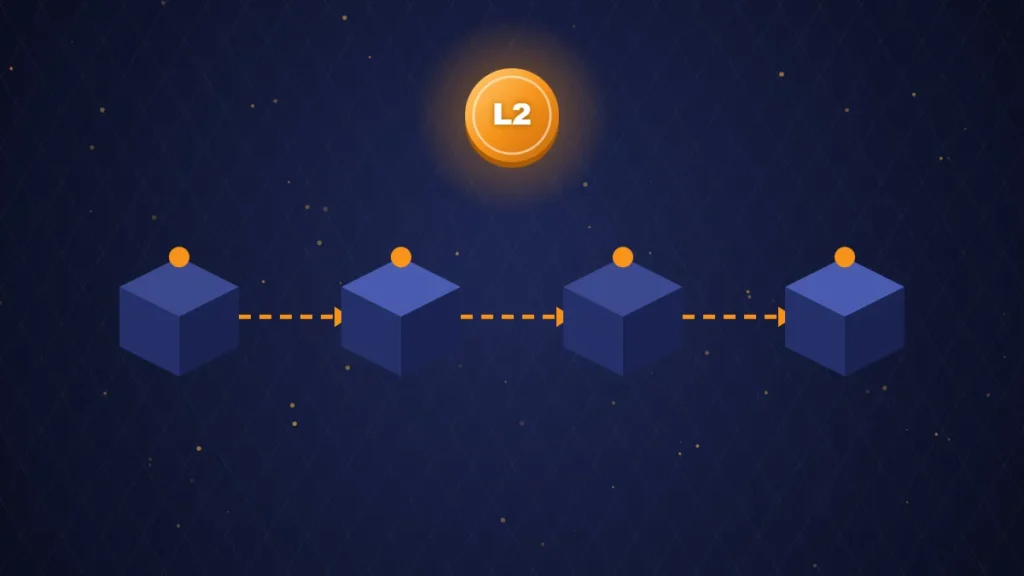
A layer 2 processes transactions off the main chain, then posts summarized data and proofs back to it.
- You send a transaction on the layer 2.
- The layer 2 bundles thousands of transactions.
- It posts the bundle and a proof to the layer 1.
- The layer 1 secures the final result.
Analogy: the layer 1 is a busy courthouse. A layer 2 is a notary office that handles small cases quickly and files the paperwork at the courthouse in batches.
Types of layer 2
| Type | How it proves correctness | Examples |
|---|---|---|
| Optimistic rollup | Assumes valid; allows challenges for a period | Arbitrum, Optimism, Base |
| ZK rollup | Posts cryptographic validity proofs | zkSync, Starknet, Linea |
| Payment channels | Off-chain balances between parties | Bitcoin Lightning Network |
Layer 1 vs layer 2 comparison
| Feature | Layer 1 | Layer 2 |
|---|---|---|
| Security | Its own | Borrowed from layer 1 |
| Fees | Can be higher | Usually much lower |
| Speed | Varies | Fast |
| Coin for fees | Native coin | Often the layer 1's coin (e.g., ETH) |
| Extra risks | Fewer moving parts | Bridges, sequencers, upgrade keys |
Risks of layer 2s
- Bridge risk: moving funds between layers relies on contracts that can be hacked.
- Centralized sequencers: many layer 2s are still run by one operator.
- Withdrawal delays: optimistic rollups can take about a week to withdraw directly to Ethereum.
- Wrong network: sending to an address on the wrong layer can cause losses.
Frequently Asked Questions
Is Solana a layer 2?
No. Solana is a layer 1 with its own validators.
Do I need ETH on a layer 2?
On most Ethereum layer 2s, yes: gas is paid in ETH.
Are layer 2s safe?
They inherit much of Ethereum's security, but add bridge and operator risks.
How do I move funds to a layer 2?
Use the official bridge, or withdraw directly from an exchange to that network.
What is the Lightning Network?
A layer 2 for Bitcoin that enables fast, cheap payments through channels.
Sources
- Ethereum.org – Layer 2: https://ethereum.org/en/layer-2/
- L2BEAT – Layer 2 risk analysis: https://l2beat.com/
- Lightning Network: https://lightning.network/
This guide is for education only and is not financial, investment or tax advice. Always do your own research and only invest what you can afford to lose. See our Disclaimer and Editorial Policy.