
Last updated November 27, 2026. Educational content only, not financial advice. Crypto prices can fall sharply and you can lose money.
Quick answer: What is Solana? Solana is a fast, low-cost blockchain for apps, payments, stablecoins and meme coins. Its coin, SOL, pays transaction fees and is staked by validators to secure the network. Solana is known for very cheap transactions, usually a fraction of a cent.
- Solana’s main network has run since March 2020 (CoinGecko via SteamDB).
- SOL hit its all-time high of about $293 on January 19, 2025 (CoinGecko; Datawallet).
- SOL traded near $72.83 on November 17, 2026, down about 44% in a year (CoinGecko via SteamDB).
- SOL has no maximum supply; new coins are issued as staking rewards (Datawallet).
- The Alpenglow upgrade, a new consensus system for faster finality, switched on for mainnet in late 2026 (crypto.news).
Quick facts
| Item | Detail |
|---|---|
| Symbol | SOL |
| Launch year | 2020 (mainnet beta in March) |
| Founder / team | Anatoly Yakovenko and Raj Gokal; Solana Labs, Solana Foundation and Anza |
| Consensus method | Proof of stake with Proof of History; moving to Alpenglow consensus |
| Max supply | No maximum; yearly inflation that falls over time |
| Circulating supply | About 580–590 million SOL (2026, source: CoinGecko) |
| Official website | https://solana.com |
| Whitepaper / docs | https://solana.com/docs |
| Block explorer | https://solscan.io and https://explorer.solana.com |
What is Solana?
Solana is a smart contract blockchain built for speed.
Like Ethereum, it runs apps such as exchanges, lending markets, games and NFT marketplaces. Unlike Ethereum’s main chain, it aims to do everything on one fast layer, without needing separate layer-2 networks.
Key parts:
- SOL: the coin used for fees and staking.
- Validators: computers that stake SOL and produce blocks.
- Programs: Solana’s name for smart contracts.
- Ecosystem: apps like Jupiter, Raydium, Phantom wallet and many meme coin launchpads.
Example: A user swaps $20 of USDC for a token on Jupiter. The swap finishes in about a second and costs less than one cent.
History and founders
Solana was started by Anatoly Yakovenko, a former Qualcomm engineer, who described Proof of History in a 2017 paper.
Key moments:
- 2017: Yakovenko publishes the Solana whitepaper.
- March 2020: Solana’s mainnet beta goes live.
- November 2021: SOL reaches about $260 during the bull market (DEXTools).
- November 2022: SOL crashes after the collapse of FTX, a major backer.
- 2022–2023: The network has several outages; reliability improves after upgrades.
- January 19, 2025: SOL reaches its all-time high of about $293 (DEXTools; Datawallet).
- 2025–2026: Spot SOL exchange-traded funds trade in the US and see record inflows (CoinGecko).
- Late 2026: The Alpenglow upgrade switches on for mainnet (crypto.news).
How does Solana work?
Solana combines proof of stake with a clock called Proof of History to process many transactions quickly.
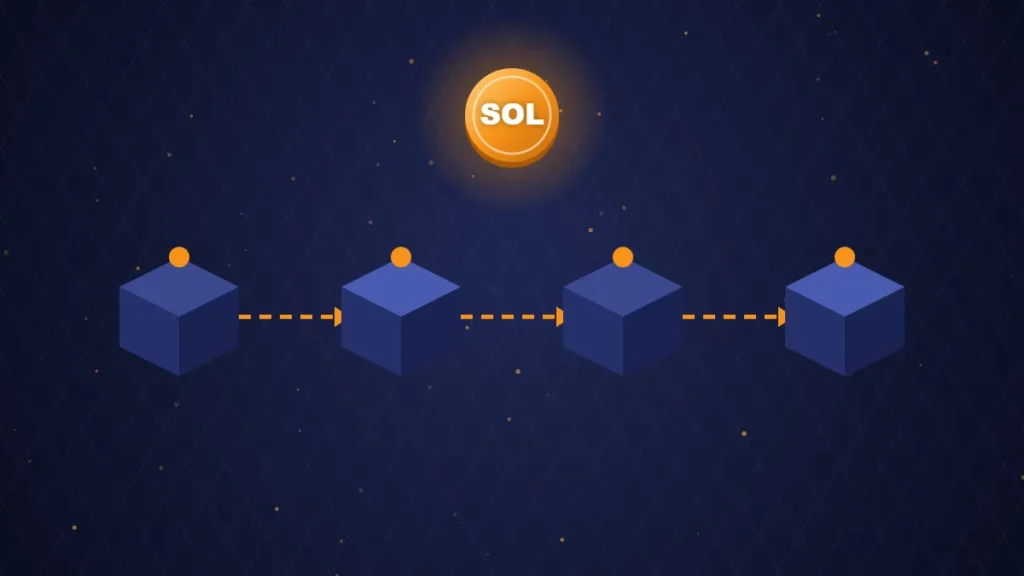
- You send a transaction. For example, buying a token.
- You pay a tiny fee in SOL. Users can add a priority fee when the network is busy.
- A leader validator orders transactions. Validators take turns as leader.
- Proof of History timestamps them. This shared clock helps validators agree on order without long messaging.
- Validators vote. Stake-weighted votes confirm blocks; Alpenglow aims to make this final in a fraction of a second.
Analogy: Most blockchains are like a meeting where everyone must agree on the time before each decision. Solana gives everyone the same clock, so the meeting moves much faster.
Tokenomics and supply
SOL has no fixed maximum supply.
- Inflation: new SOL is issued to stakers. The rate started at 8% a year and falls by 15% each year toward a long-term 1.5% (Solana docs).
- Fee burn: part of each transaction fee is burned.
- Staking: most SOL is staked with validators, earning rewards.
- Supply: about 580–590 million SOL circulating in 2026 (CoinGecko; Binance Square).
What this means: Non-stakers are slowly diluted by new issuance, while stakers earn rewards that roughly offset inflation.
Example: If you stake 10 SOL at a 7% reward rate, you could earn about 0.7 SOL in a year, before validator fees. Rates change.
What is Solana used for?
- DeFi: trading, lending and liquidity on apps like Jupiter and Kamino.
- Stablecoins and payments: cheap USDC and USDT transfers.
- Meme coins: fast launchpads made Solana the home of many meme tokens.
- NFTs and games: low fees suit small, frequent actions.
- Staking: earning rewards by delegating SOL.
Example: A shop accepts USDC payments on Solana and receives funds in seconds with almost no fee.
Where can you buy Solana?
- Coinbase, Kraken, Binance, OKX, Bybit and many others list SOL (check availability in your country).
- Wallet apps such as Phantom let you buy SOL with a card.
- In the US, spot SOL ETFs trade on stock exchanges.
How to buy Solana step by step
- Check the rules. Make sure the exchange is legal where you live.
- Create and secure your account. Complete KYC and turn on 2FA.
- Deposit funds. Use local currency or USDT.
- Find SOL. Search for SOL/USDT.
- Place your order. Market or limit order.
- Withdraw on the Solana network. Send to a Solana wallet such as Phantom or Solflare. Send a small test first.
Worked $100 example (illustration only, not a price quote): If SOL costs $73 and the fee is 0.1%, you pay $0.10 in fees and receive about $99.90 ÷ $73 ≈ 1.37 SOL.
How to store Solana safely
- Popular wallets: Phantom, Solflare and hardware wallets such as Ledger.
- Keep a little SOL for fees and token account rent.
- Do not sign transactions you do not understand. "Drainer" sites can empty wallets with one signature.
- Ignore unknown tokens and NFTs that appear in your wallet; many are scams.
- Keep your seed phrase offline and never share it.
Pros and cons
| Pros | Cons |
|---|---|
| Very fast and cheap transactions | Past network outages |
| Large DeFi and meme coin ecosystem | Validators need expensive hardware |
| Staking rewards | No maximum supply |
| Spot ETFs in the US | Many scam tokens and drainer sites |
| Faster finality with Alpenglow | Price is far below its 2025 high |
Risks to know
- Volatility. SOL fell from about $293 in January 2025 to about $73 in November 2026 (CoinGecko).
- Reliability. Solana had several outages in 2022–2023. New upgrades aim to prevent this.
- Meme coin cycles. Network fees and activity depend a lot on meme coin trading (Datawallet).
- Scams. Fake tokens, rug pulls and wallet drainers are common.
- Centralisation concerns. Running a validator is costly, which limits who can join.
Price history
| Date | Event | Price (USD) | Source |
|---|---|---|---|
| May 11, 2020 | All-time low | About $0.50 | Datawallet |
| November 2021 | Previous record high | About $260 | DEXTools |
| January 19, 2025 | All-time high | About $293 | DEXTools / Datawallet |
| September 27, 2026 | Two-month rally | About $124 | 24/7 Wall St. |
| November 17, 2026 | Market sell-off | About $72.83 | CoinGecko via SteamDB |
Solana vs Ethereum
| Feature | Solana (SOL) | Ethereum (ETH) |
|---|---|---|
| Launch | 2020 | 2015 |
| Scaling approach | One fast main chain | Main chain plus layer-2 networks |
| Typical fee | Fraction of a cent | Cents on layer-2, more on mainnet |
| Consensus | Proof of stake + Proof of History | Proof of stake |
| Supply | No max, falling inflation | No max, part of fees burned |
| Strengths | Speed, low cost, meme coins | Security, decentralisation, DeFi depth |
Frequently Asked Questions
Is Solana a good investment?
No one can predict prices. SOL is very volatile. Only invest what you can afford to lose.
What is Proof of History?
A cryptographic clock that timestamps transactions, helping validators agree on order quickly.
What is Alpenglow?
A new consensus system for Solana that aims to confirm blocks much faster. It switched on for mainnet in late 2026.
Can I stake SOL?
Yes. You can delegate SOL to a validator from wallets like Phantom or Solflare, or use liquid staking tokens. Rewards vary.
Why does my Solana wallet need SOL?
Every transaction pays a small fee in SOL, and new token accounts need a small deposit.
Is Solana the same as Ethereum?
No. Both run apps, but Solana uses a different design, coin and programming tools.
Sources
- Solana – Documentation: https://solana.com/docs
- CoinGecko – Solana price: https://www.coingecko.com/en/coins/solana
- SteamDB – SOL price on November 17, 2026: https://steamdb.com/en/crypto/solana
- DEXTools – Solana all-time high explained: https://www.dextools.io/news/solana-chain-all-time-high-explained-the-journey-to-the-new-ath
- crypto.news – Solana after Alpenglow's mainnet switch: https://crypto.news/solana-price-prediction-for-november-after-alpenglows-mainnet-switch/
This guide is for education only and is not financial, investment or tax advice. Always do your own research and only invest what you can afford to lose. See our Disclaimer and Editorial Policy.