
Last updated November 27, 2026. Educational content only, not financial advice. Crypto prices can fall sharply and you can lose money.
Quick answer: What is Bitcoin? Bitcoin is the first cryptocurrency, launched in 2009 by an unknown person or group called Satoshi Nakamoto. It is digital money that people can send to each other without a bank. Only 21 million bitcoin can ever exist, and a global network of computers keeps the records.
- Bitcoin launched on January 3, 2009, and is still the largest cryptocurrency by market value (CoinMarketCap).
- Its supply is capped at 21 million BTC; about 20.11 million were already in circulation in November 2026 (Blockchain.com).
- New bitcoin is created by mining, and the reward is cut in half about every four years in an event called the halving.
- Bitcoin reached its all-time high of about $126,198 on October 6, 2025, then fell to around $62,000–$65,000 in mid-November 2026 (CoinMarketCap; CoinGecko).
- Price swings are large, so beginners should only use money they can afford to lose.
Quick facts
| Item | Detail |
|---|---|
| Symbol | BTC |
| Launch year | 2009 (genesis block on January 3) |
| Founder / team | Satoshi Nakamoto (identity unknown); maintained by open-source developers worldwide |
| Consensus method | Proof of work (SHA-256 mining) |
| Max supply | 21,000,000 BTC |
| Circulating supply | About 20,112,712 BTC (November 2026, source: Blockchain.com) |
| Official website | https://bitcoin.org |
| Whitepaper / docs | https://bitcoin.org/bitcoin.pdf |
| Block explorer | https://mempool.space |
What is Bitcoin?
Bitcoin is a digital currency that works without a central bank, company or government in charge.
Instead of a bank keeping a list of who owns what, Bitcoin uses a public record called a blockchain. Thousands of computers around the world keep a copy of this record and check every new payment against the rules.
Key parts:
- Bitcoin (the network): the software and computers that run the system.
- bitcoin or BTC (the coin): the money that moves on the network.
- Wallet: an app or device that holds the keys needed to send your bitcoin.
- Miners: computers that bundle payments into blocks and secure the network.
Example: Ali in Lahore can send bitcoin to his brother in Riyadh at any hour, on any day. No bank has to approve it, and the payment is recorded on the blockchain for anyone to check.
History and founders
Bitcoin was created by Satoshi Nakamoto, who published the Bitcoin whitepaper on October 31, 2008, and mined the first block in January 2009.
Satoshi’s real identity has never been confirmed. Satoshi stopped posting publicly in 2010 and 2011, and since then Bitcoin has been maintained by independent developers.
Key moments:
- October 31, 2008: Satoshi Nakamoto publishes the Bitcoin whitepaper (Bitcoin.org).
- January 3, 2009: The first block, called the genesis block, is mined.
- May 22, 2010: A programmer buys two pizzas for 10,000 BTC, often called the first real-world bitcoin purchase.
- November 2021: The Taproot upgrade improves privacy and flexibility.
- January 10, 2024: The US SEC approves the first spot bitcoin exchange-traded funds (ETFs) (SEC).
- April 20, 2024: The fourth halving cuts the mining reward to 3.125 BTC per block.
- October 6, 2025: Bitcoin reaches its all-time high of about $126,198 (CoinMarketCap).
Example: Those 10,000 BTC spent on pizza in 2010 would have been worth more than $1 billion at the 2025 peak. This story is often used to show how far bitcoin’s price has moved.
How does Bitcoin work?
Bitcoin works through a network of computers that check payments and add them to a shared record about every 10 minutes.
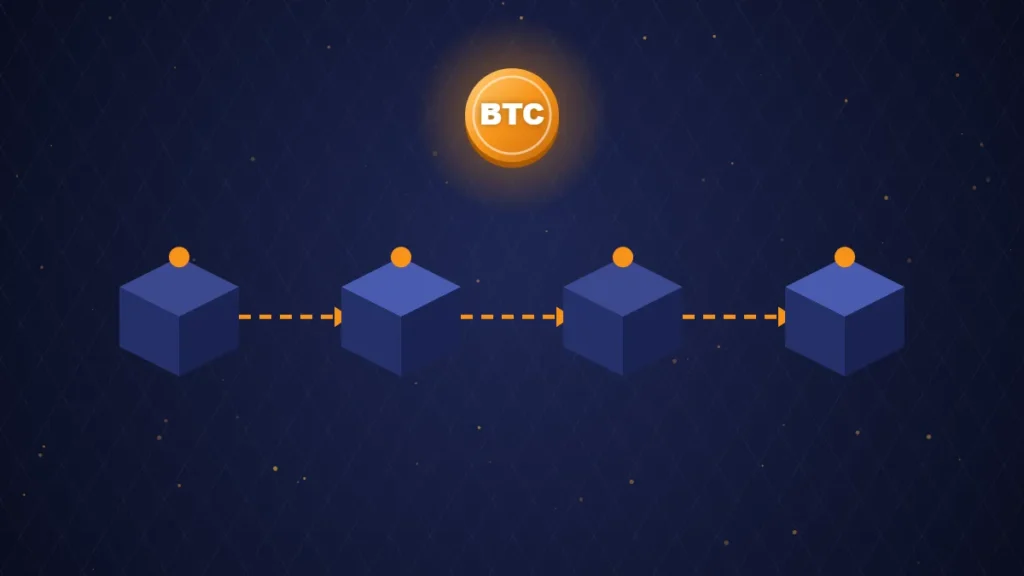
Here is the basic process:
- You send a payment. Your wallet signs the payment with your private key, which proves you own the coins.
- The network hears it. The payment spreads to computers (nodes) around the world.
- Miners collect payments. Miners group waiting payments into a block.
- Proof of work. Miners race to solve a hard maths puzzle. The winner adds the block and earns new bitcoin plus fees.
- Everyone updates. Nodes check the block. If it follows the rules, they add it to their copy of the blockchain.
Halving: about every 210,000 blocks (roughly four years), the reward for miners is cut in half. This slows the creation of new bitcoin until the 21 million limit is reached around the year 2140.
Analogy: Think of Bitcoin as a public notebook copied in thousands of places. To add a new page, someone must do a lot of work first, and everyone else checks the page before accepting it. Changing old pages would mean redoing all that work, which is why the record is very hard to fake.
Tokenomics and supply
Bitcoin has a fixed maximum supply of 21 million coins, and more than 95% have already been mined.
Key supply facts:
- Maximum supply: 21,000,000 BTC, set in the original code.
- Circulating supply: about 20.11 million BTC in November 2026 (Blockchain.com).
- Block reward: 3.125 BTC per block since the April 2024 halving.
- Next halving: expected around 2028, when the reward falls to about 1.5625 BTC.
- Lost coins: some bitcoin is lost forever because owners lost their keys, so the usable supply is lower than the official number.
What this means: No one can print more bitcoin to pay for spending. This scarcity is the main reason many people call bitcoin "digital gold."
Example: If a central bank prints more money, each note may buy less over time. Bitcoin's issuance is set in advance and drops at each halving, so new supply keeps shrinking.
What is Bitcoin used for?
Bitcoin is mostly used as a long-term store of value, but it is also used for payments and as collateral.
Common uses:
- Saving and investing: many people buy and hold bitcoin as a long-term asset.
- Cross-border payments: sending value abroad without a bank, often useful where banking is hard.
- Fast small payments: the Lightning Network, built on top of Bitcoin, allows quick and cheap transfers.
- Company treasuries: some public companies hold bitcoin on their balance sheet.
- ETFs: investors can get bitcoin exposure through spot ETFs in the US and other markets.
Example: A freelancer paid by a client overseas can receive bitcoin and convert it to local currency later. This can be faster than a bank transfer, but the value can also change while she waits.
Where can you buy Bitcoin?
You can buy bitcoin on almost every major crypto exchange and through many brokerage and payment apps.
Centralised exchanges and apps (check availability in your country):
- Large exchanges such as Binance, Coinbase, Kraken, OKX and Bybit list BTC.
- Some brokerage and payment apps also let you buy bitcoin.
- In some countries, bitcoin ETFs are available through regular stock brokers.
Peer-to-peer and other options:
- Peer-to-peer (P2P) markets let you buy from other people, but they carry higher scam risk.
- Bitcoin ATMs exist in some cities but usually charge high fees.
How to buy Bitcoin step by step
To buy bitcoin, choose a regulated exchange, verify your identity, add money, buy BTC and move it to a wallet you control if you plan to hold it long term.
- Check the rules. Make sure buying crypto is legal in your country and that the exchange is allowed to operate there.
- Create and secure your account. Complete identity checks (KYC) and turn on two-factor authentication (2FA).
- Deposit funds. Add local currency, or buy a stablecoin such as USDT first.
- Find BTC. Search for the BTC/USDT or BTC/USD pair.
- Place your order. Use a "market" order to buy now, or a "limit" order to choose your price.
- Withdraw to your wallet (optional). Send a small test amount first, then the rest, using the Bitcoin network.
Worked $100 example (illustration only, not a price quote): Suppose BTC costs $64,000 and the exchange charges a 0.1% fee.
- Fee: $100 × 0.1% = $0.10
- Money used to buy BTC: $99.90
- BTC received: $99.90 ÷ $64,000 ≈ 0.00156 BTC
You do not need to buy a whole bitcoin. One bitcoin is split into 100 million units called satoshis.
How to store Bitcoin safely
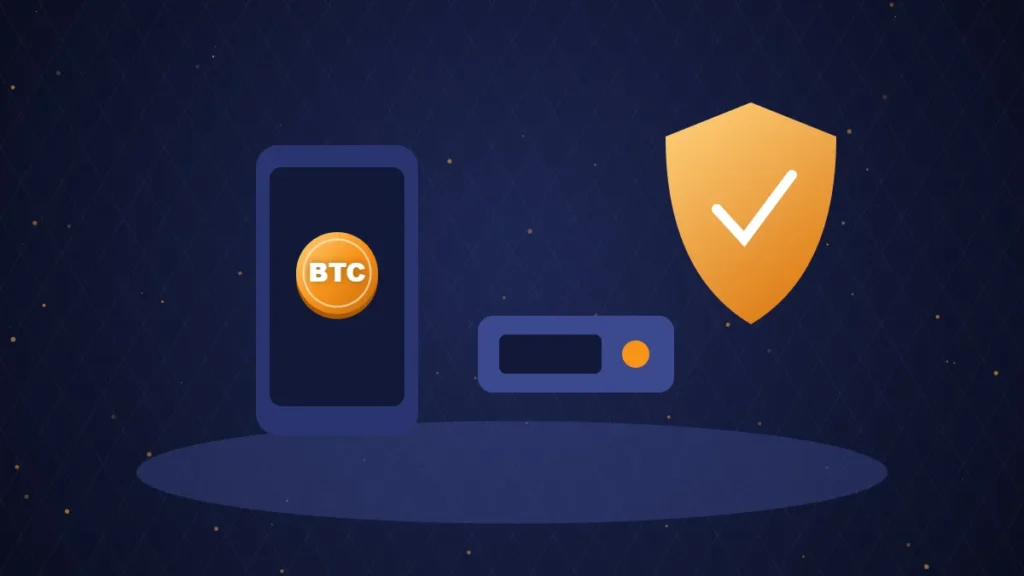
The safest way to hold bitcoin long term is in a wallet where you control the private keys.
Wallet types:
- Exchange account: easy, but the exchange holds your keys.
- Mobile or desktop wallet (hot wallet): you hold the keys, connected to the internet.
- Hardware wallet (cold wallet): a small device that keeps keys offline. Best for larger amounts.
Safety tips:
- Write your 12- or 24-word seed phrase on paper or metal and keep it offline.
- Never type your seed phrase into a website, chat or form.
- Buy hardware wallets only from the official maker.
- Double-check the address before sending. Bitcoin payments cannot be reversed.
- Be careful with "support" messages. Real support staff will never ask for your seed phrase.
Example: A user keeps a small amount in a phone wallet for spending and most of his savings on a hardware wallet stored at home, with the seed phrase written down and kept in a separate safe place.
Pros and cons
| Pros | Cons |
|---|---|
| Fixed supply of 21 million | Large price swings |
| Longest track record of any crypto | Slow and costly on-chain payments at busy times |
| Very secure, widely used network | Mining uses a lot of energy |
| Available on almost every exchange and via ETFs | Lost keys mean lost coins |
| No single company or government controls it | Rules and taxes differ by country |
| Lightning Network enables fast small payments | Price far below its October 2025 high in late 2026 |
Risks to know
The main risks for bitcoin are price volatility, losing access to your keys, scams and changes in rules.
- Price volatility. Bitcoin reached about $126,198 in October 2025 and fell to around $62,000 in November 2026, a drop of more than 50% (CoinMarketCap; CoinGecko).
- Key loss. If you lose your seed phrase, no one can recover your coins.
- Scams. Fake exchanges, "doubling" schemes and fake support accounts are common.
- Regulation. Countries can change tax rules or limit exchanges.
- Concentration. Large holders, ETFs and companies own a big share, and their selling can move the price.
- Technology. Bugs or future threats such as quantum computing are debated by developers, though no practical attack exists today.
Example: In November 2026, bitcoin had its weakest run in years as wider markets fell (Cointelegraph). Investors who bought near the top saw large paper losses.
Price history
Bitcoin went from almost nothing in 2010 to more than $126,000 in 2025, with several deep crashes along the way.
| Date | Event | Price (USD) | Source |
|---|---|---|---|
| July 14, 2010 | All-time low on record | About $0.049 | CryptoSlate |
| November 10, 2021 | Previous cycle high | About $69,000 | CoinMarketCap |
| January 10, 2024 | US spot bitcoin ETFs approved | — | SEC |
| April 20, 2024 | Fourth halving | — | Bitcoin network |
| October 6, 2025 | All-time high | About $126,198 | CoinMarketCap |
| November 17, 2026 | Price during market sell-off | About $65,022 | CoinGecko |
Bitcoin vs Ethereum
| Feature | Bitcoin (BTC) | Ethereum (ETH) |
|---|---|---|
| Launch | 2009 | 2015 |
| Main purpose | Digital money and store of value | Platform for apps and smart contracts |
| Consensus | Proof of work | Proof of stake |
| Supply | Fixed at 21 million | No fixed maximum |
| Block time | About 10 minutes | About 12 seconds |
| Smart contracts | Limited | Full support |
| ETFs in the US | Yes (since January 2024) | Yes (since July 2024) |
Frequently Asked Questions
Who created Bitcoin?
Bitcoin was created by Satoshi Nakamoto, a name used by an unknown person or group. The whitepaper was published in 2008 and the network started in January 2009.
How many bitcoin are there?
There will never be more than 21 million BTC. About 20.11 million were in circulation in November 2026.
Can I buy less than one bitcoin?
Yes. Each bitcoin is divided into 100 million satoshis, so you can buy a small amount such as $10 worth.
What is the Bitcoin halving?
It is a cut in the mining reward that happens about every four years. The last one was in April 2024, and the next is expected around 2028.
Is Bitcoin safe?
The network itself has a strong security record. Most losses come from scams, hacked exchanges or lost seed phrases, so how you store it matters.
Is Bitcoin legal?
It is legal in many countries, but rules differ. Some countries ban or limit it, so check your local laws and tax rules before buying.
Is Bitcoin a good investment?
No one can know future prices. Bitcoin has risen a lot over the long term but has also fallen more than 50% several times. Only invest what you can afford to lose.
Sources
- Bitcoin.org – Bitcoin whitepaper: https://bitcoin.org/bitcoin.pdf
- CoinMarketCap – Bitcoin price and all-time high: https://coinmarketcap.com/currencies/bitcoin/
- Blockchain.com – Bitcoin supply data: https://www.blockchain.com/prices/btc
- CoinGecko – Bitcoin historical data: https://www.coingecko.com/en/coins/bitcoin
- US SEC – Statement on spot bitcoin ETPs (January 10, 2024): https://www.sec.gov/newsroom/speeches-statements/gensler-statement-spot-bitcoin-011023
This guide is for education only and is not financial, investment or tax advice. Always do your own research and only invest what you can afford to lose. See our Disclaimer and Editorial Policy.