
Last updated November 27, 2026. Educational content only, not financial advice. Crypto prices can fall sharply and you can lose money.
Quick answer: What are stablecoins? Stablecoins are crypto tokens designed to keep a steady value, usually $1. Most are backed by cash and short-term government bonds held by a company, such as Tether’s USDT and Circle’s USDC. People use them to trade, send dollars abroad and save in dollars without a US bank account.
- Stablecoins aim for a fixed price, usually $1.
- The biggest are backed by reserves held by a company.
- They are not bank deposits and can lose their peg.
- They run on many blockchains, so the network you choose matters.
How do stablecoins work?
For reserve-backed stablecoins:
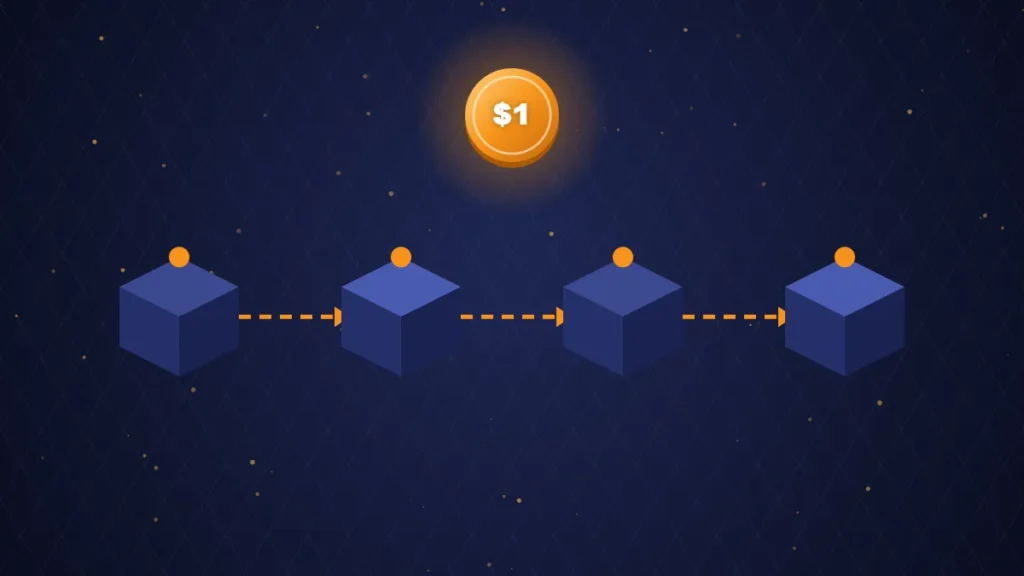
- A business sends $1 million to the issuer.
- The issuer creates 1 million tokens.
- Tokens move between wallets and exchanges.
- When someone redeems tokens, the issuer burns them and returns dollars.
- Traders buy below $1 and redeem at $1 (or the reverse), which keeps the price close to $1.
Example: a freelancer is paid 300 USDT. Its value stays near $300 even when Bitcoin moves sharply.
Types of stablecoins
| Type | Backed by | Examples | Main risk |
|---|---|---|---|
| Fiat-backed | Cash and short-term bonds | USDT, USDC | Issuer or bank problems |
| Crypto-backed | Other crypto, over-collateralised | DAI / USDS | Crypto crash, smart contract bugs |
| Algorithmic | Code and incentives | TerraUSD (collapsed in 2022) | Can break completely |
| Commodity-backed | Gold | PAXG, XAUT | Price follows gold, not $1 |
What are stablecoins used for?
- Trading: a "safe" place to park money between trades.
- Cross-border payments and remittances.
- Dollar savings in countries with high inflation.
- DeFi: lending, borrowing and liquidity.
Risks to know
- Depeg risk: USDC briefly fell to about $0.88 in March 2023 when a bank holding part of its reserves failed.
- Algorithmic failure: TerraUSD collapsed in 2022, wiping out billions.
- Freezes: issuers can freeze tokens in certain addresses.
- Wrong network: sending USDT on TRON to an Ethereum-only address can lose funds.
- Regulation: rules such as the US GENIUS Act (2025) and the EU's MiCA affect which stablecoins platforms can offer.
Frequently Asked Questions
Are stablecoins safe?
They are safer from price swings than other crypto, but they carry issuer, bank and regulatory risk.
Which stablecoin is the biggest?
Tether (USDT), followed by USDC.
Do stablecoins earn interest?
Not by themselves. Platforms that pay interest take on lending or other risks.
What does "depeg" mean?
When a stablecoin trades noticeably above or below its target, such as $0.95.
Which network should I use?
Use the same network on both the sending and receiving side. TRON and Solana are cheap; Ethereum has the deepest DeFi.
Sources
- Circle – USDC transparency: https://www.circle.com/transparency
- Tether – Transparency: https://tether.to/en/transparency
- Ethereum.org – Stablecoins: https://ethereum.org/en/stablecoins/
This guide is for education only and is not financial, investment or tax advice. Always do your own research and only invest what you can afford to lose. See our Disclaimer and Editorial Policy.