
Last updated November 27, 2026. Educational content only, not financial advice. Crypto prices can fall sharply and you can lose money.
Quick answer: What is Tether? Tether (USDT) is the world’s largest stablecoin, a crypto token designed to stay worth $1. It is issued by Tether, a company that says each USDT is backed by reserves such as US Treasury bills. People use USDT to trade crypto, send dollars across borders and hold savings in dollars.
- USDT launched in 2014 and is the largest stablecoin, with roughly 62% of the stablecoin market in November 2026 (Stablecoin Insider).
- Tether’s Q2 2026 report showed about 184.6 billion USDT in circulation, backed by about $187.75 billion in reported assets (Bit.com, citing Tether’s attestation).
- USDT runs on many blockchains; TRON alone held about $92.7 billion USDT in Q3 2026 (CoinDesk Research).
- For the US market, Tether launched a separate stablecoin, USAT, in January 2026 under the GENIUS Act (FXStreet).
- USDT aims to stay at $1, but it is not a bank deposit and carries issuer and regulatory risk.
Quick facts
| Item | Detail |
|---|---|
| Symbol | USDT |
| Launch year | 2014 (as Realcoin, renamed Tether) |
| Founder / team | Tether Limited; CEO Paolo Ardoino |
| Consensus method | None of its own: USDT is a token on TRON, Ethereum, Solana and other chains |
| Max supply | No fixed maximum; new USDT is issued when users deposit dollars |
| Circulating supply | About 184.6 billion USDT (Q2 2026 attestation, source: Tether via Bit.com) |
| Official website | https://tether.to |
| Whitepaper / docs | https://tether.to/en/transparency |
| Block explorer | https://tronscan.org and https://etherscan.io (search USDT) |
What is Tether?
Tether is a digital dollar: a token that tries to keep a steady value of one US dollar on blockchains.
Most crypto prices go up and down a lot. A stablecoin like USDT lets people stay in crypto without that price risk, and move dollars between wallets and exchanges in minutes, at any time.
Key parts:
- USDT: the dollar token used by traders and payment users worldwide.
- Tether (the company): issues and redeems USDT and manages the reserves.
- Reserves: mostly US Treasury bills, plus other assets such as gold and bitcoin, according to Tether’s reports.
- USAT: a separate US-regulated stablecoin Tether launched for American users in 2026.
Example: A freelancer in Pakistan is paid by a client abroad in USDT. She keeps the money in dollars, then sells part of it for rupees when she needs cash.
History and founders
Tether started in 2014 as Realcoin, created by Brock Pierce, Reeve Collins and Craig Sellars, and was renamed Tether later that year.
Key moments:
- 2014: Realcoin launches and is renamed Tether.
- 2019: USDT launches on TRON, which later becomes its biggest network.
- 2021: Tether settles with the New York Attorney General over past reserve statements and agrees to publish regular reserve reports.
- July 2025: USDT passes $160 billion in market cap (Cointelegraph).
- July 18, 2025: The US GENIUS Act becomes law, creating federal rules for payment stablecoins.
- January 2026: Tether launches USAT, issued by Anchorage Digital Bank under the GENIUS Act (FXStreet).
- Q2 2026: Circulating USDT reaches about 184.6 billion (Tether attestation via Bit.com).
How does Tether work?
Tether issues a new USDT when a verified customer sends it one dollar, and destroys USDT when someone redeems it for dollars.
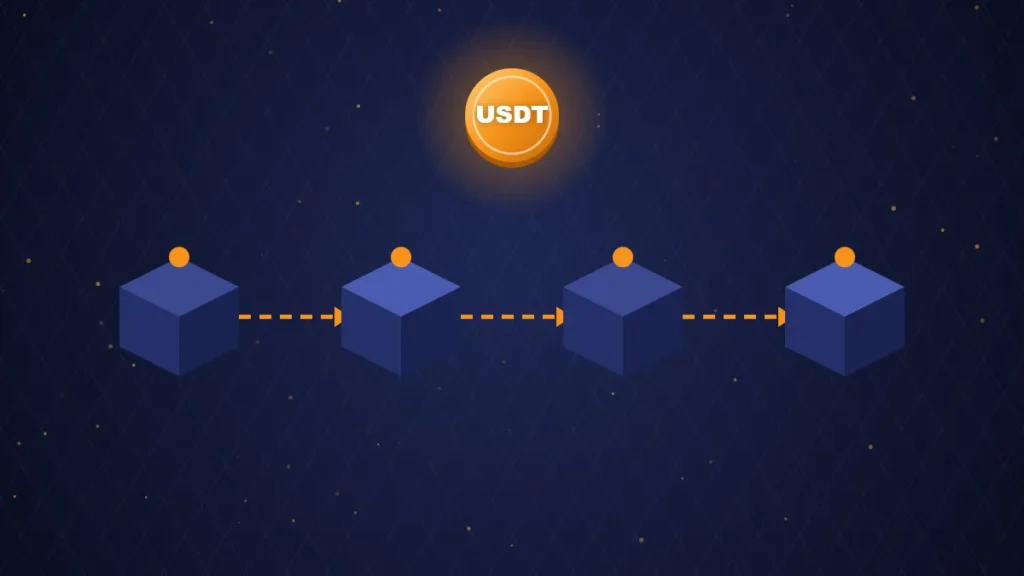
Here is the basic process:
- Deposit. A large, verified customer sends US dollars to Tether.
- Issue. Tether creates the same amount of USDT on a blockchain.
- Circulate. The USDT moves through exchanges, apps and wallets.
- Redeem. A verified customer returns USDT and gets dollars back; Tether destroys those tokens.
- Reserves. Tether invests reserves, mainly in short-term US Treasuries, and publishes quarterly reports.
Arbitrage keeps the price near $1. If USDT trades below $1, traders can buy it cheaply and redeem it for $1; if it trades above $1, they can create new USDT and sell it.
Analogy: USDT is like a casino chip worth $1. You hand over a dollar and get a chip you can use anywhere in the building. Later you hand the chip back and get your dollar, as long as the cashier still has the money.
Tokenomics and supply
USDT has no fixed supply; it grows when demand for digital dollars rises and shrinks when people redeem.
- Circulating supply: about 184.6 billion USDT in Q2 2026 (Tether attestation via Bit.com).
- Market share: about 62% of a roughly $286 billion stablecoin market in November 2026 (Stablecoin Insider).
- Biggest network: TRON held about $92.7 billion USDT in Q3 2026, around half of all USDT (CoinDesk Research).
- No price upside: USDT is meant to stay at $1, so holding it does not earn price gains.
Example: If traders want dollars during a market crash, Tether may issue billions of new USDT in a few weeks. When they cash out, supply falls again.
What is Tether used for?
USDT is used mainly for trading, cross-border payments and dollar savings in countries with weak currencies.
- Trading: most crypto pairs on big exchanges are priced in USDT.
- Remittances and business payments: cheap, fast transfers, especially on TRON.
- Dollar savings: people in high-inflation countries hold USDT to protect value.
- DeFi: lending and liquidity pools on Ethereum and other chains.
Example: A trader sells bitcoin for USDT during a fall to "park" money without leaving the exchange.
Where can you buy Tether?
You can buy USDT on almost every crypto exchange and on many peer-to-peer markets.
- Binance, OKX, Bybit, KuCoin and many others list USDT (check availability in your country).
- In the US, regulated platforms are moving to GENIUS Act-compliant coins such as USDC and USAT, so USDT access may differ (Stablecoin Insider).
- Many exchanges run P2P markets where you buy USDT with local bank transfers. Use escrow and check the seller's rating.
How to buy Tether step by step
- Check the rules. Make sure crypto is legal in your country and the platform operates there.
- Create and secure your account. Complete KYC and turn on 2FA.
- Deposit or use P2P. Add local currency or use the P2P market.
- Buy USDT. Choose the USDT market or a P2P offer.
- Pick the right network. For example TRC-20 (TRON) or ERC-20 (Ethereum). Sending and receiving networks must match.
- Send a test first. Send a small amount, check it arrived, then send the rest.
Worked $100 example (illustration only): If USDT is $1.00 and a P2P seller charges 1% above the market rate, $100 buys about 99 USDT. Withdrawal network fees are extra.

How to store Tether safely
- TRON USDT needs a TRON wallet and a little TRX for network fees.
- Ethereum USDT needs an Ethereum wallet and ETH for gas.
- Hardware wallets support USDT on several networks.
- Never send USDT on one network to an address on another unless the wallet supports both.
- Beware of "address poisoning": scammers send tiny amounts from look-alike addresses. Always copy addresses from a trusted source.
Pros and cons
| Pros | Cons |
|---|---|
| Aims to stay at $1 | Issuer risk: you rely on Tether's reserves |
| Largest and most widely accepted stablecoin | Not a bank deposit; no deposit insurance |
| Fast and cheap on networks like TRON | Tether can freeze USDT in some addresses |
| Available on almost every exchange | Not GENIUS Act-compliant for US platforms |
| Useful for dollar savings and payments | Past legal issues over reserve disclosures |
Risks to know
- Issuer risk. If reserves lost value or could not be sold quickly, USDT could lose its $1 peg.
- Regulation. US platforms must move away from non-compliant dollar tokens under GENIUS Act timelines, and other countries have their own rules (Stablecoin Insider).
- Freezes. Tether can freeze tokens linked to crime or sanctions.
- Scams. Fake "USDT investment" schemes and address poisoning are common.
- Wrong network. Sending on the wrong chain can lose funds.
Price history
USDT is designed to stay at $1, so its history is mostly about the peg and supply.
| Date | Event | Value | Source |
|---|---|---|---|
| 2014 | Launch as Realcoin, renamed Tether | $1 target | Tether |
| July 2025 | Market cap passes $160 billion | — | Cointelegraph |
| Q4 2025 | Market cap about $187.3 billion | — | Cointelegraph |
| Q2 2026 | About 184.6 billion USDT circulating | — | Tether via Bit.com |
| November 2026 | About 62% of stablecoin market | — | Stablecoin Insider |
Tether vs USDC
| Feature | Tether (USDT) | USD Coin (USDC) |
|---|---|---|
| Issuer | Tether (offshore) | Circle (US company) |
| Launch | 2014 | 2018 |
| Supply (late 2026) | About $180 billion | About $68–74 billion |
| Main networks | TRON, Ethereum | Ethereum, Solana, Base |
| US GENIUS Act status | Not compliant (Tether offers USAT instead) | Built for US rules |
| Main users | Global traders, emerging markets | US platforms, DeFi, institutions |
Frequently Asked Questions
Is USDT always worth $1?
It aims to be, and it usually trades very close to $1. Short dips below $1 have happened during market stress.
Who backs USDT?
Tether says USDT is backed by reserves, mostly US Treasury bills, plus other assets such as gold and bitcoin. It publishes quarterly reports.
Which network should I use for USDT?
TRON (TRC-20) is cheap and popular; Ethereum (ERC-20) is widely supported in DeFi. Always use the same network on both sides.
Can I earn interest on USDT?
Some platforms offer yield, but it comes from lending or other risks. Tether itself does not pay holders interest.
What is USAT?
USAT is a separate stablecoin from Tether made for the US market under the GENIUS Act, issued by Anchorage Digital Bank.
Is USDT safe?
It is widely used, but it depends on Tether's reserves and on rules in your country. Do not treat it as a bank account.
Sources
- Tether – Transparency page: https://tether.to/en/transparency
- Stablecoin Insider – Tether USAT vs USDT: https://stablecoininsider.org/tether-usat-vs-usdt-whats-different-and-who-can-use-it/
- CoinDesk Research – TRON Network Q3 2026: https://www.coindesk.com/research/tron-network-q3-2026
- Cointelegraph – USDT market cap hits $160B: https://cointelegraph.com/news/tether-usdt-market-cap-hits-160b-emerging-markets-growth
- FXStreet – Tether launches USAT under GENIUS Act: https://www.fxstreet.com/amp/cryptocurrencies/news/tether-launches-usat-to-operate-within-us-markets-under-genius-act-framework-202601280852
This guide is for education only and is not financial, investment or tax advice. Always do your own research and only invest what you can afford to lose. See our Disclaimer and Editorial Policy.