
Last updated November 27, 2026. Educational content only, not financial advice. Crypto prices can fall sharply and you can lose money.
Quick answer: What is USDC? USD Coin (USDC) is a stablecoin designed to stay worth $1. It is issued by Circle, a US company listed on the New York Stock Exchange, and is backed by cash and short-term US Treasuries. People use USDC for trading, payments, DeFi and holding digital dollars.
- USDC launched in September 2018 and is the second-largest stablecoin after Tether’s USDT.
- About 68.9 billion USDC was in circulation on November 18, 2026 (CoinGecko via Crypto Briefing).
- In Q3 2026, USDC had $13.9 trillion in onchain transaction volume, up 49% from a year earlier (Circle via Mitrade).
- Circle publishes weekly reserve reports; reserves are mostly overnight repos and Treasuries under three months (Circle via edgeX).
- USDC briefly fell to about $0.88 in March 2023 when a bank holding part of its reserves failed (Messari).
Quick facts
| Item | Detail |
|---|---|
| Symbol | USDC |
| Launch year | 2018 |
| Founder / team | Circle (CEO Jeremy Allaire); originally launched with Coinbase through the Centre consortium |
| Consensus method | None of its own: USDC is a token on Ethereum, Solana, Base and many other chains |
| Max supply | No fixed maximum; USDC is created and redeemed 1:1 for dollars |
| Circulating supply | About 68.9 billion USDC (November 18, 2026, source: CoinGecko) |
| Official website | https://www.circle.com/usdc |
| Whitepaper / docs | https://www.circle.com/transparency |
| Block explorer | https://etherscan.io and https://solscan.io (search USDC) |
What is USDC?
USDC is a digital US dollar that lives on blockchains.
Each USDC is meant to be redeemable for one US dollar through Circle. Because its value stays steady, people use it to move money quickly, pay for things and hold dollars without a traditional bank account.
Key parts:
- USDC: the dollar token itself.
- Circle: the company that issues and redeems USDC and manages the reserves.
- Reserves: cash in banks plus the Circle Reserve Fund, which holds short-term Treasuries and repos.
- Arc: Circle’s own blockchain for stablecoin payments; it held about $1.5 billion in assets on October 30, 2026 (Circle via Coinotag).
Example: An online shop in Dubai accepts USDC from a customer in Brazil. The money arrives in seconds, and the shop can redeem it for dollars.
History and founders
USDC was announced in May 2018 by Centre, a group set up by Circle and Coinbase (Messari).
Key moments:
- September 2018: USDC starts trading.
- 2023: Circle takes full control of USDC as the Centre consortium winds down.
- March 11, 2023: USDC briefly drops to about $0.88 after Silicon Valley Bank, which held part of its cash reserves, fails. It returns to $1 within days (Messari).
- June 2025: Circle lists its shares on the New York Stock Exchange.
- July 18, 2025: The US GENIUS Act becomes law, setting federal rules for payment stablecoins.
- End of 2025: USDC supply reaches about $75.3 billion, up 72% in a year (MEXC News).
- Q3 2026: USDC records $13.9 trillion in onchain volume (Circle via Mitrade).
How does USDC work?
USDC works by keeping one dollar in reserve for every token in circulation.
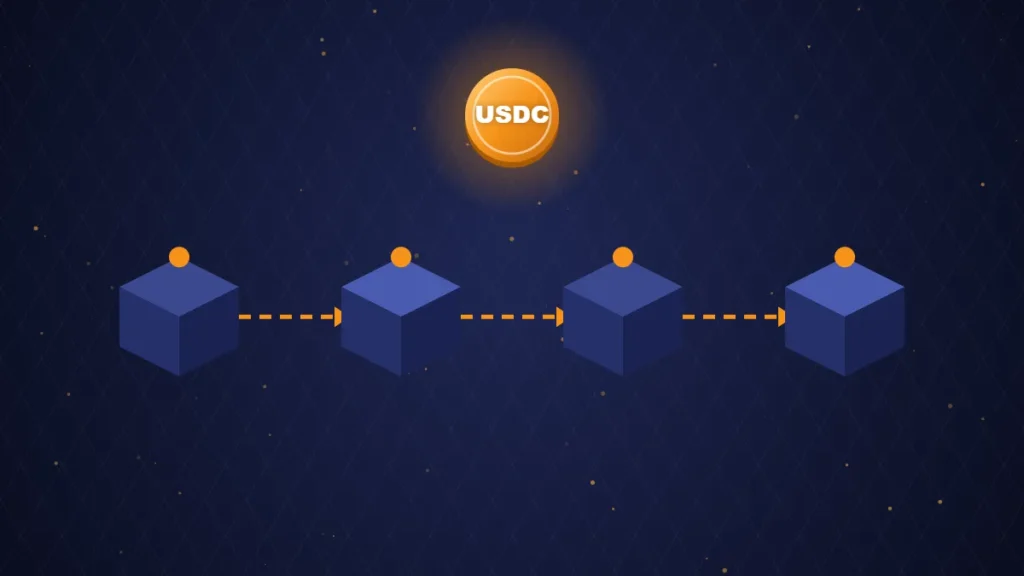
- Mint. A verified business sends dollars to Circle.
- Issue. Circle creates the same amount of USDC on the chosen blockchain.
- Use. USDC moves between wallets, exchanges and apps.
- Redeem. A verified business sends USDC back; Circle burns it and returns dollars.
- Report. Circle publishes weekly reserve numbers and monthly attestations by an accounting firm.
Analogy: USDC is like a cloakroom ticket. You hand in a dollar, get a ticket, and anyone holding the ticket can collect a dollar later.
Tokenomics and supply
USDC has no fixed supply. It grows when businesses mint and shrinks when they redeem.
- Supply in late 2026: about 67.9 billion USDC in the November 12 report, with reserves near $68.1 billion (Circle via edgeX).
- Reserves mix: about $39.9 billion in overnight reverse repos and $20.1 billion in short-term Treasuries in that report (Circle via edgeX).
- Direct bank cash: about $9.73 billion at the end of September 2026 (Circle Q3 report via Crypto Briefing).
- Supply swings: supply fell for two weeks in a row in November 2026 as redemptions outpaced new issuance (edgeX).
Example: If a big exchange needs dollars, it redeems 1 billion USDC. Circle burns those tokens and supply drops by 1 billion.
What is USDC used for?
- Trading: a dollar base on exchanges, especially in the US.
- DeFi: lending, borrowing and liquidity pools on Ethereum, Solana and Base.
- Payments: business payments, payroll and online shopping.
- Cross-border transfers: cheaper and faster than many bank wires.
- Savings in dollars: for people in countries with weak currencies.
Example: A DeFi user deposits USDC in a lending app and earns interest paid by borrowers, accepting smart contract risk.
Where can you buy USDC?
- Coinbase and many other major exchanges list USDC (check availability in your country).
- Some apps and wallets let you buy USDC with a card or bank transfer.
- On blockchains, you can swap other tokens for USDC on decentralised exchanges.
- In some countries, exchanges offer P2P markets for USDC. Use escrow and trusted sellers.
How to buy USDC step by step
- Check the rules. Make sure crypto is legal in your country.
- Pick a trusted platform. Choose a well-known exchange or wallet app.
- Create and secure your account. Complete KYC and turn on 2FA.
- Add money. Deposit local currency by bank transfer or card.
- Buy USDC. Choose USDC and confirm the amount.
- Withdraw on the right network. Pick Ethereum, Solana, Base or another network your wallet supports. Send a small test first.
Worked $100 example (illustration only): If USDC is $1.00 and your card fee is 2%, you get about 98 USDC. A bank transfer may cost less.
How to store USDC safely
- USDC on Ethereum needs ETH for gas; on Solana it needs SOL.
- Hardware wallets support USDC on several networks.
- Always check the network before sending.
- Use official contract addresses from Circle's website; fake "USDC" tokens exist.
- Keep your seed phrase offline and never share it.
Pros and cons
| Pros | Cons |
|---|---|
| Regulated US issuer, listed company | Relies on Circle and its banks |
| Weekly reserve reports | Not insured like a bank deposit |
| Works on many blockchains | Circle can freeze USDC in some addresses |
| Popular in DeFi and payments | Lost its peg briefly in March 2023 |
| Built for US stablecoin rules | No price upside: it is meant to stay at $1 |
Risks to know
- Issuer and bank risk. The March 2023 depeg showed that problems at a bank can hit USDC (Messari).
- Freezes. Circle can block addresses linked to crime or sanctions.
- Smart contract risk. Apps that hold USDC can be hacked.
- Fake tokens. Scammers create tokens named USDC.
- Regulation. Rules differ by country and can change.
Price history
| Date | Event | Price (USD) | Source |
|---|---|---|---|
| September 2018 | First trading | About $1.00 | Messari |
| October 15, 2018 | Highest recorded price | About $1.09 | Messari |
| March 11, 2023 | Brief depeg after SVB failure | About $0.885 | Messari |
| End of 2025 | Supply about $75.3 billion | $1.00 | MEXC News |
| November 18, 2026 | Supply about 68.9 billion | $1.00 | CoinGecko via Crypto Briefing |
USDC vs Tether
| Feature | USDC | Tether (USDT) |
|---|---|---|
| Issuer | Circle (US, NYSE listed) | Tether (offshore) |
| Launch | 2018 | 2014 |
| Supply (late 2026) | About $68–69 billion | About $180 billion |
| Reserve reports | Weekly figures, monthly attestations | Quarterly attestations |
| Main networks | Ethereum, Solana, Base | TRON, Ethereum |
| Main users | US platforms, DeFi, businesses | Global traders, emerging markets |
Frequently Asked Questions
Is USDC always worth $1?
It aims to be and usually is. It briefly fell to about $0.88 in March 2023 before recovering.
Who backs USDC?
Circle backs USDC with cash and short-term US government assets, reported every week.
Can I redeem USDC for dollars?
Verified Circle business customers can redeem directly. Most people sell USDC on an exchange.
Does USDC pay interest?
USDC itself does not. Some platforms offer rewards, which come with their own risks.
Is USDC safer than USDT?
USDC has more frequent reports and a US-regulated issuer, but both carry issuer risk. Neither is a bank account.
Which network is best for USDC?
Solana and Base are cheap; Ethereum has the deepest DeFi. Use the network your exchange and wallet both support.
Sources
- Circle – Transparency: https://www.circle.com/transparency
- Crypto Briefing – Circle bank cash falls in Q3: https://cryptobriefing.com/circle-usdc-bank-cash-falls-q3/
- Mitrade – USDC volume rises 49%: https://www.mitrade.com/insights/news/live-news/article-3-2240394-20261109
- edgeX – USDC redemptions outpace issuance: https://pro.edgex.exchange/en-US/news/article/usdc-supply-shrinks-1-3b-as-circle-redemptions-top-mints
- Messari – USDC profile: https://messari.io/asset/circle-usdc-stablecoin
This guide is for education only and is not financial, investment or tax advice. Always do your own research and only invest what you can afford to lose. See our Disclaimer and Editorial Policy.