
Last updated November 26, 2026. Educational content only, not financial advice. Crypto prices can fall sharply and you can lose money.
Quick answer: What is Uniswap? It is a decentralised exchange (DEX) that lets people swap crypto tokens straight from their own wallets, using smart contracts instead of a company. It launched on Ethereum in November 2018 and now runs on many networks. UNI is its governance token; since late 2025, some fees buy and burn UNI.
- Uniswap was created by Hayden Adams and launched on Ethereum on November 2, 2018. It is run by smart contracts, not a central exchange.
- It uses an “automated market maker”: pools of tokens provided by users set prices with a formula, so anyone can trade at any time.
- UNI launched in September 2020 with 1 billion tokens; about 621.4 million were circulating as of November 26, 2026 (CoinGecko).
- In December 2025, holders approved “UNIfication,” turning on a fee switch that uses protocol fees to buy and burn UNI, plus a one-time burn of 100 million UNI.
- Swapping on Uniswap carries risks such as price slippage, scam tokens and smart-contract bugs.
Quick facts
| Item | Detail |
|---|---|
| Symbol | UNI |
| Launch year | 2018 (protocol, November 2); 2020 (UNI token, September) |
| Founder / team | Hayden Adams; developed by Uniswap Labs; governed by UNI holders, supported by the Uniswap Foundation |
| Consensus method | No own blockchain for the protocol; UNI is an ERC-20 token on Ethereum (proof of stake). Uniswap also runs Unichain, an Ethereum layer-2 |
| Max supply | Started at 1,000,000,000 UNI; governance can mint up to 2% a year (since September 2024); burns now reduce supply |
| Circulating supply | About 621,384,000 UNI (as of November 26, 2026, source: CoinGecko) |
| Official website | https://uniswap.org |
| Whitepaper / docs | https://docs.uniswap.org |
| Block explorer | https://etherscan.io/token/0x1f9840a85d5af5bf1d1762f925bdaddc4201f984 |
What is Uniswap?
Uniswap is a set of smart contracts that lets anyone swap one crypto token for another without signing up for an exchange account.
On a normal exchange, a company holds your money and matches buyers with sellers. On Uniswap, you connect your own wallet, choose the tokens to swap, and the smart contract completes the trade using a shared pool of tokens. You keep control of your funds until the moment of the swap.
Anyone can also add tokens to the pools and earn a share of the trading fees. These people are called liquidity providers (LPs).
Example: Nadia has USDC in her wallet and wants ETH. She opens the Uniswap app, connects her wallet, chooses USDC → ETH, checks the price and confirms. Seconds later, ETH appears in her wallet. No account, no identity check by Uniswap and no waiting for a buyer.
History and founders
Uniswap was created by Hayden Adams, a former mechanical engineer who learned to code smart contracts after being laid off, and launched in November 2018.
Adams was inspired by an idea from Ethereum co-founder Vitalik Buterin about automated market makers. He built Uniswap with a grant from the Ethereum Foundation.
Key moments:
- November 2, 2018: Uniswap v1 launches on Ethereum.
- May 2020: Uniswap v2 adds direct token-to-token pools and price oracles.
- September 2020: The UNI token launches. Many past users received 400 UNI each in an airdrop. UNI’s all-time low was recorded on September 17, 2020.
- May 2021: Uniswap v3 launches, letting LPs focus their liquidity in chosen price ranges. UNI reaches its all-time high around the same time.
- 2025: Uniswap v4 launches with customisable “hooks,” and Unichain, Uniswap’s own Ethereum layer-2, goes live.
- February 2025: The US SEC closes its investigation into Uniswap Labs without action.
- December 2025: UNI holders pass the “UNIfication” proposal with 99.9% support, activating the protocol fee switch and a one-time burn of 100 million UNI.
- 2026: The fee switch expands to more networks and to v4 pools across seven networks by July 2026.
Example: Uniswap’s story is like a market stall that a single engineer set up with a small grant, which grew into one of the busiest markets in crypto, run by rules everyone can read.
How does Uniswap work?
Uniswap works with liquidity pools: users deposit pairs of tokens into a pool, and a mathematical formula sets the price based on how much of each token is in the pool.
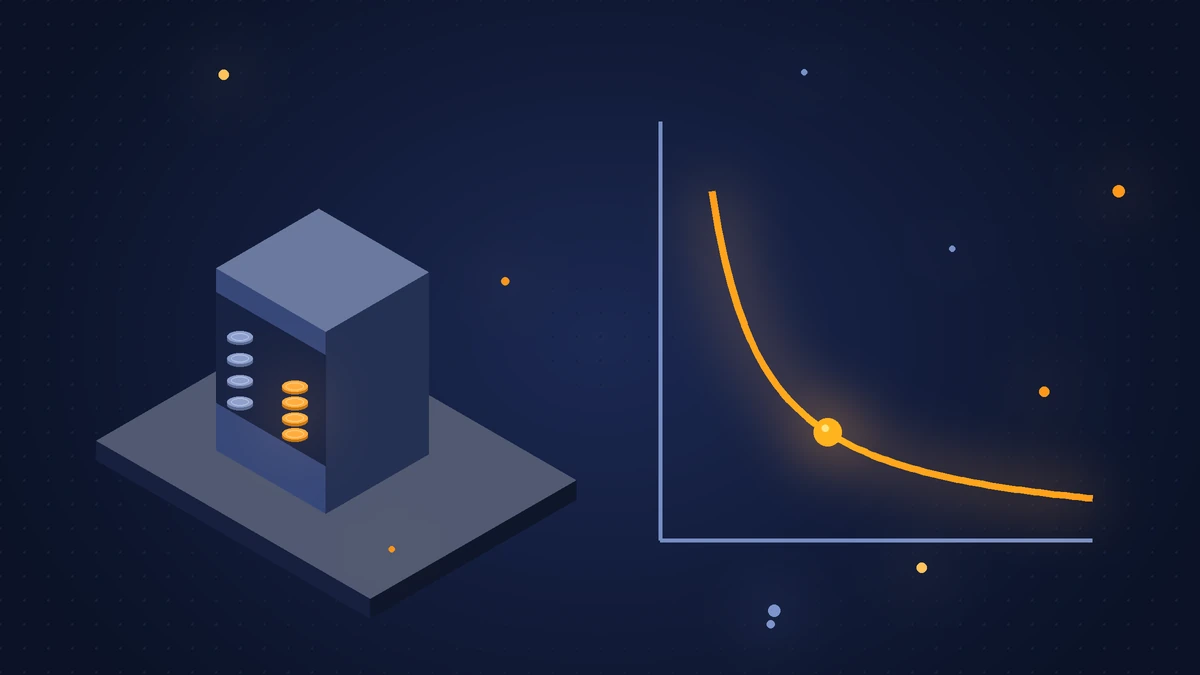
Liquidity pools. Each pool holds two tokens, such as ETH and USDC. LPs deposit both tokens and receive a share of the pool.
Automated market maker (AMM). In the classic design, the pool keeps the product of the two token amounts constant (x × y = k). When you buy ETH from a pool, there is less ETH and more USDC in it, so the price of ETH in that pool rises a little.
Fees. Each swap pays a fee, often between 0.01% and 1% depending on the pool. Most of the fee goes to LPs. Since the fee switch, part of some pools’ fees goes to the protocol to buy and burn UNI.
Versions. v3 lets LPs choose price ranges to use their money more efficiently. v4 adds “hooks,” small custom programs that can change how a pool behaves.
Governance. UNI holders vote on proposals, such as fee settings and treasury spending, or delegate their votes to others.
Consensus. Uniswap does not have its own consensus for most pools; it relies on the blockchain it runs on, such as Ethereum’s proof of stake.
Analogy: Picture a vending machine with two piles of fruit, apples and oranges. When people take apples and put in oranges, apples become scarcer in the machine, so the machine automatically charges more oranges for each apple. People who stocked the machine earn a small fee each time someone trades.
Tokenomics and supply
UNI started with 1 billion tokens, about 621.4 million are in circulation, and protocol burns now reduce the total over time.
| Supply item | Detail |
|---|---|
| Genesis supply (September 2020) | 1,000,000,000 UNI |
| Circulating supply | About 621,384,000 UNI (CoinGecko, as of November 26, 2026) |
| Total supply | About 886,330,000 UNI after burns (CoinGecko, as of November 26, 2026) |
| One-time burn | 100 million UNI burned from the treasury after UNIfication passed in December 2025 |
| Ongoing burns | Protocol fees from eligible pools buy and burn UNI |
| Possible inflation | Governance may mint up to 2% a year (allowed since September 2024) |
| Original allocation | 60% community, about 21.3% team, about 18% investors, about 0.7% advisors |
Why is circulating supply lower than total supply? A large amount of UNI sits in the community treasury, controlled by governance, and is not counted as circulating.
How big are the burns? In 2026, founder Hayden Adams said the annualised burn rate had passed $250 million, according to a report published on KuCoin. Burn size changes with trading volume and the UNI price.
Example: If Uniswap protocol fees in a month total $10 million and all of it buys UNI at $5, about 2 million UNI would be burned that month. Lower volume means smaller burns.
What is Uniswap used for?
Uniswap is used for swapping tokens, providing liquidity, and governing the protocol; UNI itself is used for voting and benefits from fee-driven burns.
- Swapping tokens: trade thousands of tokens directly from your wallet.
- Providing liquidity: deposit tokens into pools to earn a share of trading fees.
- Price discovery for new tokens: many new tokens first trade on Uniswap.
- Building apps: other apps and wallets route trades through Uniswap's smart contracts.
- Governance: UNI holders vote on fees, treasury use and upgrades.
- Value accrual: since UNIfication, part of protocol fees buys and burns UNI.
Example: A small project launches a new token and creates a Uniswap pool with its token and ETH. Anyone can now buy or sell the token, and the project does not need to apply for an exchange listing.
Where can you buy Uniswap?
You can buy UNI on most major global crypto exchanges, and of course on Uniswap itself and other decentralised exchanges.
Centralised exchanges (check availability in your country):
- Large exchanges such as Binance, Coinbase, Kraken, OKX and Bybit list UNI.
- Many payment and brokerage apps also offer UNI in supported regions.
Decentralised options:
- On the Uniswap app, swap ETH or a stablecoin for UNI using your own wallet.
- UNI also trades on other DEXs and on layer-2 networks such as Arbitrum, Base and Unichain. Always check the official UNI contract address for each network.
Tip: On decentralised exchanges, fake tokens often copy real names. Always use the official token address from Uniswap's documentation or a trusted data site.
How to buy Uniswap step by step
You buy UNI either on a centralised exchange or by swapping for it on Uniswap with your own wallet.

- Choose your route. Use a licensed exchange in your country, or a self-custody wallet and the official Uniswap app.
- Set up your account or wallet. On an exchange, complete identity checks (KYC) and turn on 2FA. For a wallet, save your recovery phrase offline.
- Add funds. Deposit US dollars (USD) on an exchange, or move ETH or USDC into your wallet.
- Find UNI. On an exchange, search for UNI/USD or UNI/USDT. On Uniswap, select UNI using the official contract address.
- Check costs. On Uniswap, review the price impact, slippage setting and network fee before confirming.
- Confirm the trade. Place your order or approve and confirm the swap in your wallet.
- Secure your UNI. Keep it in your wallet, or move it to a hardware wallet for larger amounts.
Worked $100 example (illustration only, not a price quote): Suppose UNI costs $5.00, the exchange fee is 0.5%, and you buy on a centralised exchange.
- Fee: $100 × 0.5% = $0.50
- Money used to buy UNI: $99.50
- UNI received: $99.50 ÷ $5.00 = 19.9 UNI
- On Uniswap instead, you might pay a 0.3% pool fee ($0.30) plus a network fee, which is usually much lower on layer-2 networks than on Ethereum mainnet.
How to store Uniswap safely
You can store UNI in any wallet that supports Ethereum tokens; a hardware wallet is safest for larger amounts.
Wallet options:
- Software wallets: the Uniswap Wallet, MetaMask and other ERC-20 wallets.
- Hardware wallets: devices such as Ledger and Trezor support UNI and keep your keys offline.
- Exchange accounts: convenient, but the exchange controls your keys and you cannot vote with them.
Safety rules:
- Keep a little ETH (or the network's gas token) to pay fees.
- Check token approvals. When you swap on Uniswap, you approve the contract to use your tokens. Revoke approvals you no longer need.
- Only use the official Uniswap website. Phishing sites copy its design.
- If you want to vote, keep UNI in your own wallet and delegate your votes (you can delegate to yourself).
Example: Luis keeps UNI on a hardware wallet and delegates his voting power to a community delegate he trusts. His UNI never leaves his wallet, but his votes still count in governance.
Pros and cons
Uniswap is the most widely used decentralised exchange and UNI now has a fee-burn mechanism, but users face DeFi risks and the token's price is far below its peak.
| Pros | Cons |
|---|---|
| Swap from your own wallet, no account needed | Scam tokens can be listed by anyone |
| Large liquidity and many networks | Price slippage on large or thin trades |
| Open-source, audited smart contracts | Smart-contract and front-end risks remain |
| UNI holders govern the protocol | Voting power is concentrated among large holders |
| Fee switch now burns UNI | Burn size depends on trading volume |
| LPs can earn trading fees | LPs face "impermanent loss" when prices move |
Risks to know
The main risks for UNI and Uniswap users are price volatility, DeFi risks, governance concentration and regulation.
- Price volatility. UNI reached about $44.92 in May 2021 (CoinGecko) and has traded far below that level since.
- Scam tokens. Anyone can create a pool for any token. Fake tokens often copy famous names.
- Slippage and price impact. Large trades in small pools can get a much worse price than expected.
- Impermanent loss. LPs can end up with less value than if they had simply held their tokens when prices move a lot.
- Smart-contract and hook risk. Bugs in Uniswap contracts, v4 hooks or connected apps could cause losses.
- Governance concentration. A few large holders and delegates have strong influence over decisions.
- Regulation. Rules for DeFi, front-ends and governance tokens may change.
Example: A user tries to buy a newly launched "UNI 2.0" token on Uniswap. It is a scam token with a similar name. Once bought, it cannot be sold. Checking the official contract address would have avoided this.
Price history
UNI launched in September 2020, reached its all-time high in May 2021, and has traded far below that level since.
| Date | Event | Price (USD) | Source |
|---|---|---|---|
| September 17, 2020 | All-time low | About $1.03 | CoinGecko |
| May 3, 2021 | All-time high | About $44.92 | CoinGecko |
| December 2025 | UNIfication passes; 100 million UNI burned soon after | — | Cointelegraph / The Block |
Different data sites record different extremes. For example, CoinMarketCap shows an all-time high of about $44.97 on May 3, 2021 and a lower all-time low on launch day.
Key points:
- UNI's peak came just before the Uniswap v3 launch in May 2021.
- The fee switch was debated for years before it was finally turned on in December 2025.
- In 2026, UNI traded mostly between about $2.50 and $7, according to several market reports.
Past prices do not tell you what will happen next. This guide does not make price predictions.
Uniswap vs PancakeSwap
Uniswap and PancakeSwap are both automated market maker exchanges, but Uniswap started on Ethereum and spans many networks, while PancakeSwap began on BNB Chain.
| Feature | Uniswap (UNI) | PancakeSwap (CAKE) |
|---|---|---|
| Launch | 2018 | 2020 |
| Home network | Ethereum (plus many layer-2s and chains) | BNB Chain (plus other chains) |
| Exchange model | Automated market maker (v2, v3, v4 with hooks) | Automated market maker |
| Token role | Governance; protocol fees buy and burn UNI | Utility and governance; burns |
| Typical fees | Pool fees from 0.01% to 1% | Pool fees vary by pool |
| Own layer-2 | Unichain | No dedicated layer-2 |
Example: A user with ETH on Ethereum or Arbitrum will often swap on Uniswap. A user whose funds are on BNB Chain may find PancakeSwap more convenient and cheaper.
Frequently Asked Questions
What is Uniswap in simple words?
Uniswap is a decentralised exchange where you swap tokens directly from your own wallet. UNI is the token used to govern it.
Who created Uniswap?
Hayden Adams created Uniswap and launched it on Ethereum on November 2, 2018. Uniswap Labs develops it.
Do I need an account to use Uniswap?
No. You only need a self-custody wallet with some tokens and enough of the network's gas token to pay fees.
What is the UNI fee switch?
It is a feature approved in December 2025 that sends part of trading fees to the protocol, which uses them to buy and burn UNI.
What is the supply of UNI?
UNI started with 1 billion tokens. After burns, total supply was about 886 million, with about 621 million circulating, on November 26, 2026 (CoinGecko).
What is impermanent loss?
It is the loss liquidity providers can face when token prices in a pool change compared with simply holding the tokens.
Is Uniswap safe?
Uniswap's core contracts are widely used and audited, but risks include scam tokens, bugs, phishing sites and price slippage.
Sources
- Uniswap official website: https://uniswap.org
- Uniswap documentation: https://docs.uniswap.org
- CoinGecko – Uniswap (UNI) market data: https://www.coingecko.com/en/coins/uniswap
- Cointelegraph – Uniswap executes 100M UNI burn after fee switch approval: https://cointelegraph.com/news/uniswap-executes-100m-uni-burn-after-fee-switch-approval
- DefiLlama – Uniswap UNIfication and fee switch overview: https://defillama.com/pro/defi20-uniswap-0orcp8
This guide is for education only and is not financial, investment or tax advice. Always do your own research and only invest what you can afford to lose. See our Disclaimer and Editorial Policy.