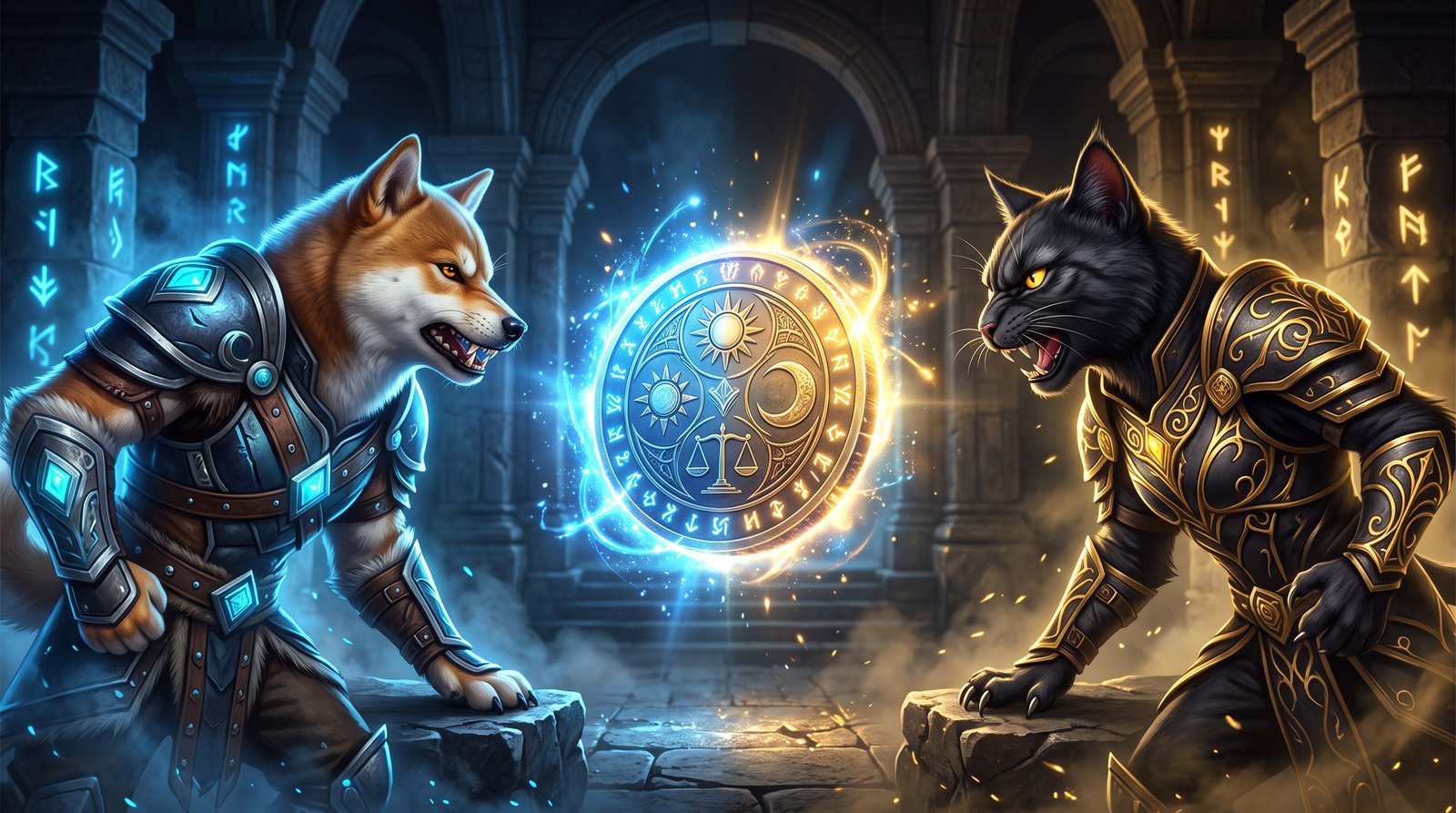
- DOGE vs SHIB: Why This Comparison Matters in 2026
- Tokenomics Face-Off: Dogecoin vs Shiba Inu Supply and Burns
- Price Action History: DOGE vs SHIB All-Time Highs
- Market Cap, Adoption, and Real-World Use
- Community, Ecosystem, and Utility Differences
- Technicals: Support and Resistance for Both Tokens
- Which Meme Coin Has More Potential? Our DOGE vs SHIB Verdict
The doge vs shib debate is one of the oldest questions in meme coin investing. This article compares Dogecoin and Shiba Inu across market cap, tokenomics, all-time high, community strength, ecosystem development, and price action to answer which meme coin has more potential in 2026. You will learn how each token's supply model works, why Dogecoin still leads on adoption while Shiba Inu leads on utility, and which support and resistance levels matter for traders. We finish with a clear, data-driven verdict rather than a popularity contest.
DOGE vs SHIB: Why This Comparison Matters in 2026
Dogecoin and Shiba Inu are the two largest meme coins by market cap, and together they hold tens of billions of dollars in investor capital. Their rivalry predates most of the altcoin market, with DOGE launching in 2013 and SHIB in 2020. Understanding the doge vs shib dynamic matters because the two tokens now compete not just for attention but for liquidity, exchange listings, and institutional adoption.
Two Tokens, Two Philosophies
Dogecoin was built as a joke that became a payments network, while Shiba Inu was designed as a self-described Dogecoin killer with an ecosystem of DeFi, NFTs, and a layer-2 chain. One is a proof-of-work currency in the mold of Litecoin; the other is an Ethereum-based token wrapped in a utility narrative. These philosophical differences drive almost every measurable gap between the two tokens.
Why Investors Compare Them
Investors compare doge vs shib because both occupy the same mental category: dog-themed meme coins. When one rallies, traders often expect rotation into the other. When one suffers bad news, the other frequently feels the spillover. Studying both side by side reveals which has better tokenomics, which community is more durable, and which is better positioned for the next bull market.
The 2026 Context
By 2026, the meme coin market has matured. Institutional players trade DOGE futures on the Chicago Mercantile Exchange, and SHIB has a working layer-2 with real transaction volume. Both projects must now deliver on promises made during the 2021 mania. This doge vs shib analysis evaluates each token against those promises and against the harsh reality of market cycles.
The Emotional Factor in the Rivalry
The rivalry is emotional as well as financial. Dogecoin's early adopters see SHIB as a copycat, while Shiba Inu's community believes its utility and burns make it the superior asset. These tribal loyalties produce real market effects, because committed holders are less likely to sell in a downturn and more likely to buy in a recovery. Understanding the emotion behind each community helps explain why both tokens retain such large, sticky user bases.
At the same time, tribalism blinds investors to objective data. The most useful posture is to ignore the feuds and compare fundamentals: market cap, tokenomics, adoption, and technicals. That is exactly what this doge vs shib analysis does, and it is the approach that has historically produced better decisions than arguing in comment sections.
Tokenomics Face-Off: Dogecoin vs Shiba Inu Supply and Burns
Tokenomics separates doge vs shib more than any other factor. One has inflationary supply and no burning; the other launched with a quadrillion tokens and a burning mechanism. Supply design directly affects price action, scarcity narrative, and long-term value retention.
Dogecoin's Inflationary Model
Dogecoin has a maximum supply of roughly 150 billion tokens, with about 10,000 new DOGE minted every minute and roughly 5.25 billion added per year. This inflation was intentional: it keeps transaction fees low and the currency circulating. However, it also means DOGE has no scarcity narrative, and its price rises only when demand grows faster than new supply.
Shiba Inu's Massive Initial Supply and Burns
Shiba Inu launched with a total supply of 1 quadrillion SHIB, half of which was locked into a Uniswap pool and half gifted to Vitalik Buterin, who burned most of it. Roughly 549 trillion tokens have been burned over time, reducing supply dramatically. This deflationary design gives SHIB a scarcity story that DOGE simply cannot tell.
Which Supply Model Is Better?
For pure price mechanics, SHIB's burn-driven supply reduction is more attractive. For adoption and payments, DOGE's stable inflation is an advantage. The honest answer in any doge vs shib comparison is that DOGE's model supports its role as money, while SHIB's model supports its role as a speculative asset with ecosystem ambitions.
Circulating Supply and Fully Diluted Value
Investors should also compare circulating supply against fully diluted value. Dogecoin is almost fully emitted, which means the market price already reflects nearly every token that will ever exist. Shiba Inu, by contrast, still carries a large share of supply locked in ecosystem contracts, so its fully diluted valuation is higher than its circulating market cap suggests. This difference affects how both tokens price in future supply events.
In practice, DOGE's near-complete emission makes its price action simpler to read, because there is no schedule of future unlocks to worry about. SHIB's remaining locked supply creates the risk that large amounts could eventually enter circulation, even if the team repeatedly stresses that those tokens are reserved for the ecosystem. A careful doge vs shib review must factor this into long-term expectations.
- DOGE: ~150 billion max supply, ~5.25 billion inflation per year, no burns
- SHIB: 1 quadrillion initial supply, ~549 trillion burned to date, ongoing burn events
- DOGE: proof-of-work with the Scrypt algorithm, fast settlement
- SHIB: ERC-20 on Ethereum, bridged to the Shibarium layer-2
Price Action History: DOGE vs SHIB All-Time Highs
Price history defines how investors think about doge vs shib. Both tokens produced once-in-a-generation rallies during the 2021 bull market and have spent years digesting those gains. The all-time highs remain powerful resistance levels for both assets.
DOGE's 2021 Explosion to $0.73
Dogecoin's all-time high of $0.7376 came in May 2021, driven by retail mania and Elon Musk's relentless promotion. At the peak, DOGE's market cap touched roughly $90 billion, making it briefly the fourth-largest cryptocurrency. The 2021 run transformed DOGE from internet joke into a permanent fixture of the crypto top ten.
SHIB's Meteoric 2021 Rise
Shiba Inu reached its all-time high of $0.00008845 in October 2021, just months after launch, with a peak market cap near $41 billion. The run made early holders into millionaires and minted SHIB as the leading Ethereum meme coin. The speed of that rally, roughly 40 million percent from its earliest trading levels, remains unmatched in crypto.
What Recent Cycles Reveal
Since those peaks, both tokens have consolidated. DOGE has printed higher lows in recent years, supported by institutional demand and payments adoption, while SHIB has leaned on ecosystem milestones like Shibarium upgrades. Traders should treat the 2021 all-time highs as the ultimate resistance, understanding that a retest requires a new bull cycle.
| Metric | Dogecoin (DOGE) | Shiba Inu (SHIB) |
|---|---|---|
| Launch Year | 2013 | 2020 |
| Max Supply | ~150 billion | 1 quadrillion (549T burned) |
| All-Time High | $0.7376 (May 2021) | $0.00008845 (Oct 2021) |
| Peak Market Cap | ~$90 billion | ~$41 billion |
| Blockchain | Dogecoin PoW | Ethereum + Shibarium |
| Consensus | Proof-of-Work (Scrypt) | Proof-of-Stake ecosystem |
Market Cap, Adoption, and Real-World Use
Market cap is the first number investors check, but adoption tells a deeper story. This section measures where doge vs shib stand today on real-world usage, merchant acceptance, and institutional interest.
Current Market Cap Standing
As of early 2026, Dogecoin's market cap is generally in the $40-$60 billion range, while Shiba Inu typically trades between $15-$25 billion. The gap reflects DOGE's longer history and broader recognition rather than superior technology. In any doge vs shib comparison, market cap is the simplest measure of which token the market trusts more.
Real-World Adoption
DOGE is accepted by thousands of merchants through payment processors, is integrated into Tesla merchandise, and trades on regulated futures venues. SHIB, by contrast, focuses on its own ecosystem: the ShibaSwap DEX, Shibarium layer-2, and the SHIB collectible line. For everyday payments, DOGE wins; for ecosystem activity, SHIB is more ambitious.
Transaction Volume and Network Activity
On-chain activity tells a different story than market cap. Dogecoin consistently processes hundreds of thousands of transactions per day, reflecting real payment and tipping use. Shiba Inu's activity is more concentrated in its own layer-2, Shibarium, which processes millions of cheap transactions during active periods but sees usage drop sharply when speculative interest fades.
For anyone doing a rigorous doge vs shib assessment, this distinction is important. DOGE's usage is organic and steady because it functions as money, while SHIB's usage spikes with ecosystem promotions and meme seasons. Steady usage supports long-term liquidity; spiky usage creates volatility. Neither is wrong, but they point to very different risk profiles for holders.
Institutional and Retail Interest
DOGE has the clearest institutional footprint, with futures contracts on regulated exchanges and occasional whale accumulation visible on-chain. SHIB attracts strong retail communities across the United States, India, and the Philippines, and its lower price per token makes it psychologically accessible to small buyers. Both signals matter, but they attract different investor profiles.
Community, Ecosystem, and Utility Differences
A meme coin is only worth what its community believes it is worth. Comparing doge vs shib on community strength and ecosystem output explains why both tokens survive years of hype and crash.
The Dogecoin Community
Dogecoin's community is the oldest and arguably the most loyal in crypto, famous for tipping culture and charitable giving. It has survived every bear market since 2014. The downside is that the community is nostalgic, and much of DOGE's price action still depends on Elon Musk's social media activity, a dependency that creates volatility.
The Shiba Inu Ecosystem
Shiba Inu built a full product suite: ShibaSwap for trading, Shibarium for cheap transactions, Shib the Metaverse, and multiple tokens such as LEASH, BONE, and TREAT tied to the ecosystem. Shibarium gives SHIB a genuine utility story and real transaction volume that most meme coins lack. This is SHIB's strongest argument in the doge vs shib debate.
Utility as a Differentiator
DOGE offers payments and tipping; SHIB offers DeFi, an NFT ecosystem, and a layer-2. If the next cycle rewards utility, SHIB is better positioned. If it rewards brand recognition and cultural icon status, DOGE remains supreme. That is the crux of which meme coin has more potential, and the answer depends on your timeframe.
NFT, DeFi and Metaverse Roadmaps
Shiba Inu's roadmap extends beyond Shibarium into the Shib the Metaverse and a growing NFT ecosystem, which keeps the project in development news even when prices are flat. Dogecoin's roadmap is comparatively minimal, focused on the core currency, network upgrades, and merchant integration. For investors who value shipping cadence, SHIB clearly offers more product milestones to trade around.
The counterpoint is that DOGE does not need a roadmap to remain valuable. Its cultural status and payments adoption are self-sustaining, and its lack of ambitious product promises means fewer broken promises to disappoint the market. In the doge vs shib debate, SHIB's roadmap is a catalyst when executed and a liability when delayed, while DOGE simply has less to get wrong.
- DOGE: oldest community, tipping culture, heavy Musk dependence
- SHIB: younger but global, huge social following, active ecosystem builders
- Both hold top-five positions in social engagement among meme coins
- SHIB ships more products and has more active development repositories
Technicals: Support and Resistance for Both Tokens
Technical levels help traders time entries and exits in both tokens. Below are the key support and resistance zones based on recent price action, which this doge vs shib guide updates with every major cycle.
Dogecoin Key Levels
For DOGE, the critical support zone is the $0.12-$0.14 range, which has held multiple times since 2023, with stronger support near $0.08. Resistance sits at the 2021 all-time high near $0.74, with an intermediate barrier around $0.30-$0.35. A breakout above $0.35 with rising volume has historically triggered the largest speculative moves.
Shiba Inu Key Levels
For SHIB, support near $0.000013-$0.000015 has repeatedly attracted buyers, with a deeper floor around $0.000008. Resistance at the all-time high of $0.00008845 remains distant, but an intermediate ceiling near $0.00003-$0.00004 has capped rallies. SHIB's enormous supply means these levels are wide, and volatility between them is high.
Correlation and Rotation
DOGE and SHIB are highly correlated because both are dog-themed meme coins reacting to the same macro signals. When DOGE breaks out, SHIB frequently follows within days. Traders can use this correlation to rotate capital between the two, but must remember that correlation breaks down in crashes, when the larger market cap token usually falls less.
A Risk-Managed Trading Approach
Whichever side of the doge vs shib trade you favor, risk management comes first. Meme coins move 10-30% in a single session, so traders should define stop levels before entering and never risk more than a small percentage of their account on one position. Using the support and resistance levels above to time entries reduces the emotional cost of volatility.
A common strategy is to hold a core position in one token and trade the other on rotations between the two. Because their correlation is high, a move in DOGE often precedes a move in SHIB, and vice versa. This approach lets investors stay exposed to the sector while using the pairing to manage timing, which is the most practical way to trade the pair.
Which Meme Coin Has More Potential? Our DOGE vs SHIB Verdict
After weighing market cap, tokenomics, price action, adoption, community, and technicals, we can give a direct answer. Neither token is a guaranteed winner, but the doge vs shib risk-reward profile differs meaningfully in 2026.
Dogecoin's Case
DOGE wins on brand, history, adoption, and institutional access. It is the only meme coin that functions as a real payment currency and the only one with regulated futures. If you want lower relative volatility and exposure to mainstream crypto adoption, DOGE is the safer of the two, though its inflation caps explosive upside.
Shiba Inu's Case
SHIB wins on tokenomics, utility, and upside potential. Its burn program and layer-2 give it catalysts that DOGE lacks, and its lower market cap means more room to multiply. If you can tolerate higher volatility and want maximum speculative upside within the dog meme sector, SHIB offers a more asymmetric opportunity.
The doge vs shib question is really a question about risk tolerance. Dogecoin offers adoption and stability within a meme; Shiba Inu offers utility and explosive upside. Choose the one that matches your time horizon, not the loudest tweet. - Crypto30x Research
The Final Answer
For risk-adjusted exposure, Dogecoin has more potential as a store of meme value and a payments asset. For maximum upside in a bullish scenario, Shiba Inu has more potential because of its burn dynamics and ecosystem growth. Most balanced investors hold both or choose based on risk tolerance. For deeper context, read our PEPE coin analysis and our FLOKI analysis to see how the challengers stack up against the two giants. Note that this content is educational and does not constitute financial advice; always conduct your own research before investing in cryptocurrency.