
Last updated November 27, 2026. Educational content only, not financial advice. Crypto prices can fall sharply and you can lose money.
Quick answer: What is Ethereum? Ethereum is a blockchain that runs apps and smart contracts, launched in 2015 by Vitalik Buterin and co-founders. ETH is its native coin. People use ETH to pay network fees, and holders can stake it to help secure the network and earn rewards.
- Ethereum launched on July 30, 2015, and is the second-largest cryptocurrency by market value (CoinMarketCap).
- It moved from mining to proof of stake in September 2022, an event called the Merge.
- Much of DeFi, stablecoins, NFTs and layer-2 networks are built on Ethereum.
- ETH reached its all-time high of about $4,950 in August 2025, then fell to around $1,860–$1,880 in late November 2026 (CoinGecko; crypto.news).
- The next big upgrade, Glamsterdam, went live on the Sepolia testnet in October 2026; a mainnet date had not been fixed in November 2026.
Quick facts
| Item | Detail |
|---|---|
| Symbol | ETH |
| Launch year | 2015 (mainnet on July 30) |
| Founder / team | Vitalik Buterin and co-founders including Gavin Wood and Joseph Lubin; Ethereum Foundation supports research |
| Consensus method | Proof of stake (since the Merge in September 2022) |
| Max supply | No fixed maximum supply |
| Circulating supply | About 120.7 million ETH (2026, source: CoinMarketCap) |
| Official website | https://ethereum.org |
| Whitepaper / docs | https://ethereum.org/whitepaper |
| Block explorer | https://etherscan.io |
What is Ethereum?
Ethereum is a shared world computer: a blockchain where anyone can run programs, called smart contracts, that no single company controls.
Bitcoin mainly records who owns which coins. Ethereum also stores and runs code. That code powers apps for trading, lending, games, digital art and stablecoins.
Key parts:
- Ethereum (the network): the blockchain and the computers that run it.
- ETH (the coin): used to pay fees, called gas, and for staking.
- Smart contracts: programs that run automatically when conditions are met.
- Layer-2 networks: faster, cheaper networks such as Arbitrum and Base that settle back to Ethereum.
Example: A shop owner in Karachi accepts USDC, a dollar stablecoin that runs on Ethereum. The payment arrives in minutes, and a smart contract, not a bank, moves the money.
History and founders
Ethereum was proposed by programmer Vitalik Buterin in late 2013 and launched in July 2015 after a public token sale in 2014.
Key moments:
- Late 2013: Vitalik Buterin publishes the Ethereum whitepaper (ethereum.org).
- July 30, 2015: Ethereum mainnet launches.
- July 2016: After the DAO hack, Ethereum forks; the old chain continues as Ethereum Classic.
- September 15, 2022: The Merge moves Ethereum to proof of stake and cuts its energy use by more than 99%.
- March 2024: The Dencun upgrade makes layer-2 networks much cheaper.
- July 2024: Spot ether ETFs start trading in the US.
- May 2025: The Pectra upgrade improves wallets and staking.
- August 2025: ETH reaches its all-time high of about $4,950 (CoinGecko).
- December 3, 2025: The Fusaka upgrade adds PeerDAS and raises layer-2 data capacity.
- October 2026: Glamsterdam activates on the Sepolia testnet (FXStreet).
Example: The 2016 split is why two coins exist today: ETH on the main Ethereum chain and ETC on the original chain.
How does Ethereum work?
Ethereum works by having validators, who stake ETH, check transactions and add a new block about every 12 seconds.
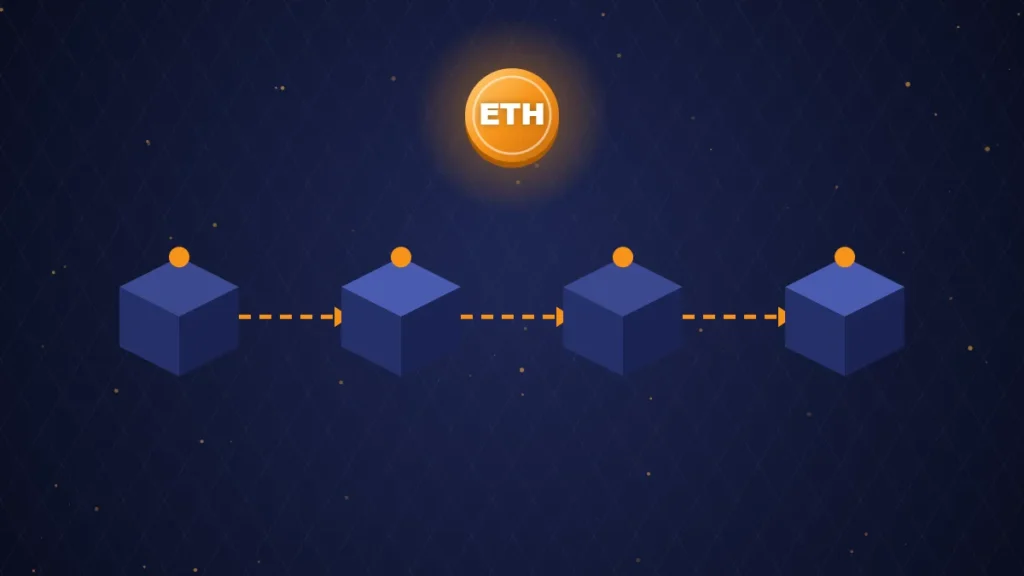
Here is the basic process:
- You send a transaction. It could be a simple ETH payment or a call to a smart contract.
- You pay gas. Gas is a fee in ETH. Part of it is burned and part goes to validators.
- Validators propose and vote. A validator proposes a block, and others check and vote on it.
- Smart contracts run. Every node runs the same code and reaches the same result.
- The block is final. After enough votes, the block becomes very hard to reverse.
Staking: to run a validator, you lock 32 ETH. Smaller holders can join staking pools. Validators that break the rules can lose part of their stake.
Analogy: Think of Ethereum as a giant shared spreadsheet that also runs formulas. Anyone can add a formula, everyone gets the same answer, and a group of guardians (validators) with money at stake keeps it honest.
Tokenomics and supply
ETH has no fixed maximum supply, but part of every fee is burned, which can slow or even reverse supply growth.
Key supply facts:
- Circulating supply: about 120.7 million ETH in 2026 (CoinMarketCap).
- Issuance: new ETH is paid to validators as staking rewards.
- Burn: since 2021 (EIP-1559), the base fee of each transaction is destroyed.
- Net effect: when the network is busy, burning can be larger than issuance; when it is quiet, supply grows slowly.
What this means: ETH is not capped like bitcoin. Its supply depends on network use and staking.
Example: On a busy day with many trades, more ETH is burned than created. On a quiet day, a small amount of new ETH is added.
What is Ethereum used for?
Ethereum is used for DeFi, stablecoins, tokenised assets, NFTs and as a base layer for layer-2 networks.
Common uses:
- DeFi: lending, borrowing and trading on apps such as Aave and Uniswap.
- Stablecoins: large amounts of USDT and USDC move on Ethereum.
- Tokenised assets: banks and funds issue tokenised treasuries and funds on Ethereum.
- NFTs and games: digital collectibles and in-game items.
- Staking: holders stake ETH to earn rewards.
Example: A user deposits ETH on a lending app and borrows USDC against it, without a bank. If ETH's price falls too far, the app can sell her ETH to repay the loan, so this carries real risk.
Where can you buy Ethereum?
You can buy ETH on almost every major crypto exchange and swap for it on decentralised exchanges.
Centralised exchanges and apps (check availability in your country):
- Large exchanges such as Binance, Coinbase, Kraken, OKX and Bybit list ETH.
- In some countries, ether ETFs are available through stock brokers.
Decentralised options:
- On Ethereum and its layer-2 networks, you can swap stablecoins for ETH on apps like Uniswap, using a self-custody wallet.
How to buy Ethereum step by step
To buy ETH, use a regulated exchange, verify your account, add money, buy ETH and move it to a wallet you control if you plan to hold it.
- Check the rules. Make sure crypto is legal in your country and the exchange is allowed there.
- Create and secure your account. Complete identity checks (KYC) and turn on two-factor authentication (2FA).
- Deposit funds. Add local currency, or buy USDT first.
- Find ETH. Search for the ETH/USDT or ETH/USD pair.
- Place your order. Use a "market" order to buy now, or a "limit" order to set your price.
- Withdraw carefully. Choose the correct network (Ethereum mainnet or a supported layer-2), send a small test first, then the rest.
Worked $100 example (illustration only, not a price quote): Suppose ETH costs $1,870 and the exchange charges a 0.1% fee.
- Fee: $100 × 0.1% = $0.10
- Money used to buy ETH: $99.90
- ETH received: $99.90 ÷ $1,870 ≈ 0.0534 ETH
How to store Ethereum safely
Hold long-term ETH in a wallet where you control the keys, and be careful which apps you approve.
Wallet types:
- Exchange account: simple, but the exchange holds your keys.
- Software wallet: apps like MetaMask or Rabby; you hold the keys.
- Hardware wallet: keeps keys offline; best for larger amounts.
Safety tips:
- Keep your seed phrase offline and never share it.
- Only connect your wallet to sites you typed yourself or bookmarked.
- Read what you sign. Malicious "approve" requests can drain tokens.
- Review and remove old token approvals from time to time.
- Make sure you send on the right network; sending to the wrong one can lose funds.
Pros and cons
| Pros | Cons |
|---|---|
| Largest smart contract platform | No fixed supply cap |
| Home to most DeFi and stablecoin activity | Mainnet fees can rise when busy |
| Proof of stake uses little energy | Complex for beginners (gas, networks, approvals) |
| Staking rewards for holders | Strong competition from Solana and others |
| Regular upgrades and big developer community | Upgrades can be delayed |
| Spot ETFs available in the US | Price far below its 2025 high in late 2026 |
Risks to know
The main risks for ETH are price swings, smart contract hacks, scams and competition.
- Price volatility. ETH reached about $4,950 in August 2025 and traded near $1,870 in late November 2026 (CoinGecko; crypto.news).
- Smart contract risk. Apps built on Ethereum can have bugs and be hacked.
- Phishing. Fake sites and malicious approvals are a common way people lose ETH.
- Upgrade risk. Big upgrades such as Glamsterdam are tested carefully but can slip or have issues.
- Competition. Other chains compete for users and developers.
- Regulation. Rules on staking, DeFi and stablecoins can change.
Price history
| Date | Event | Price (USD) | Source |
|---|---|---|---|
| October 21, 2015 | All-time low on record | About $0.42 | CoinMarketCap |
| November 10, 2021 | Previous cycle high | About $4,890 | CoinMarketCap |
| September 15, 2022 | The Merge to proof of stake | — | ethereum.org |
| August 2025 | All-time high | About $4,950 | CoinGecko |
| December 3, 2025 | Fusaka upgrade | — | The Block |
| Late November 2026 | Price during market sell-off | About $1,870 | crypto.news |
Ethereum vs Solana
| Feature | Ethereum (ETH) | Solana (SOL) |
|---|---|---|
| Launch | 2015 | 2020 |
| Consensus | Proof of stake | Proof of stake with proof of history |
| Block time | About 12 seconds | Under 1 second |
| Scaling approach | Layer-2 networks plus upgrades | Single fast chain |
| Typical fees | Low on layer-2, higher on mainnet | Very low |
| Ecosystem size | Largest DeFi and stablecoin base | Large and fast-growing |
Frequently Asked Questions
Who created Ethereum?
Vitalik Buterin proposed Ethereum in 2013 and launched it in 2015 with co-founders including Gavin Wood and Joseph Lubin.
Is ETH the same as Ethereum?
Ethereum is the network. ETH is the coin used on it, much like fuel for a car.
What is gas on Ethereum?
Gas is the fee you pay in ETH to send a transaction or use an app. It rises when the network is busy.
Can I stake ETH?
Yes. You can run a validator with 32 ETH or join a staking service or pool with less. Rewards and risks vary by service.
What is the Glamsterdam upgrade?
It is Ethereum's next big upgrade, aimed at faster and cheaper layer-1 transactions. It went live on the Sepolia testnet in October 2026; a mainnet date was not set in November 2026.
Does ETH have a maximum supply?
No. New ETH is created for stakers, but part of every fee is burned, so supply can grow or shrink.
Is Ethereum a good investment?
No one can predict prices. ETH has had big gains and losses of more than 60%. Only invest what you can afford to lose.
Sources
- ethereum.org – What is Ethereum and the whitepaper: https://ethereum.org/whitepaper
- CoinMarketCap – Ethereum price and supply: https://coinmarketcap.com/currencies/ethereum/
- CoinGecko – Ethereum all-time high: https://www.coingecko.com/en/coins/ethereum
- The Block – How Ethereum's protocol changed in 2025: https://www.theblock.co/post/383451/how-ethereums-protocol-changed-2025
- FXStreet – Glamsterdam activates on Sepolia testnet: https://www.fxstreet.com/cryptocurrencies/news/ethereum-activates-glamsterdam-on-sepolia-testnet-why-the-price-is-falling-anyway-202610090909
This guide is for education only and is not financial, investment or tax advice. Always do your own research and only invest what you can afford to lose. See our Disclaimer and Editorial Policy.